
High-Carb/Low-fat Gear Post
Let him cook (and bake)

I’ve done three gear posts in the past. But since I ate almost the exact same meal every day on ex150, I had just pretty much perfected my equipment and it hadn’t changed in a long time. When I look back at those gear posts, almost all that stuff is still what I was using day to day on ex150. Same sauce pan, same knife, same plate, same cup, same utensils, same spatula, same scale, ..
But now that I’ve gotten into HCLF I realized I’d need to explore some more equipment options, and I’ve found some I’m pretty happy with.
I probably wouldn’t have bought any of this for just a 30 day experiment. But since I plan on doing HCLF for 3-6 months, depending on how it goes, I thought it’d be a worthwhile investment. Some of the items are also loaners from friends, which of course helped because I can just give them back in a few months.
What do I actually eat?
To understand what gear you need, you need to know what you’ll be cooking. I quickly honed in on these foods:
White rice (organic, unenriched)
Pasta (unenriched)
Homemade bread (from unenriched flour)
Beans/lentils
Oats
The rest is the same as on ex150: ground beef & vegetables, although I’m using 93/7 ground beef instead of my usual 80/20 to reduce total fat.
The oats obviously don’t need any new equipment, I just pour cold tap water over them and eat them. Surprisingly delicious.
Cooking the rice & pasta
This time, unlike during ex_rice or ex_plainrice, I am not using a rice cooker. I just cook the beef & vegetables in my pot, then pour water & rice into it, and cook the rice in there. This means the rice cooks in meat & vegetable broth, which makes it taste better, and I only have to clean up a single pot.
Cooking rice in a pot on the stove top is surprisingly simple, I have yet to mess it up. I haven’t burned the rice a single time.
For pasta, I just take the meat & vegetables out of the pot and put them on my plate, then fill the pot with water and cook the pasta in there. Finally I drain the pasta in a strainer, immediately put it back in the pot, toss my meat & vegetables (and often beans) on top, and stir it all together. Then I can take plate sized portions out of the pot and store the leftovers in it.
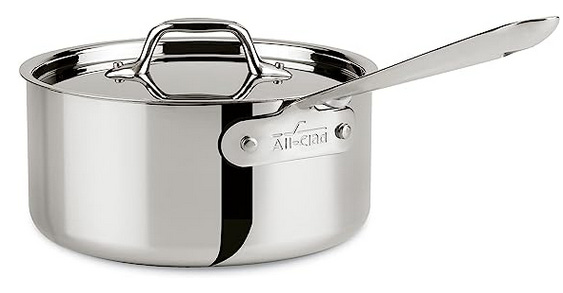
For the pot, I still use the All-Clad saucepan from a previous gear post. It cooks amazingly well, cleans up easy, and holds enough for a giant portion of rice or pasta. I can cook more in there in one go than I can eat in a day, so a bigger pot isn’t needed. The most I’ve ever cooked at one time was 2lbs (dry) of pasta.
Rice strainer
In addition, I got a rice strainer. You’re supposed to lightly rinse rice before cooking it, and you can do it in pretty much any container, but it’s pretty annoying in anything but a specialized strainer. They give you a little flimsy plastic one with your rice cooker, but I never liked it. The regular colander pasta style strainers have openings that are too big, so rice falls out.
So I just got a strainer made for the task.
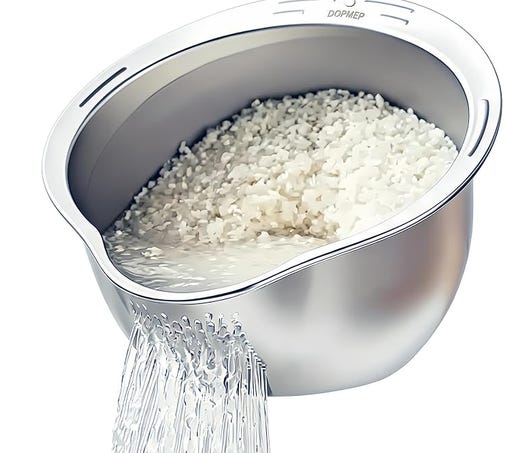
It only has holes on one side, not the bottom, so you gently tip it over in the sink, and all the water rushes out. It also has ridges on the holes so your rice isn’t swept out of the pot by the water. It’s not good for straining much else, because you typically want other things to strain out the bottom, and many things (like pasta) will actually get caught up in the little ridges near the holes and gum them up.
But for rice, it’s great. It takes me maybe 20 seconds to rinse the rice with this, instead of fiddling with something else for a minute and losing 20% of my rice in the process.
Big ladle
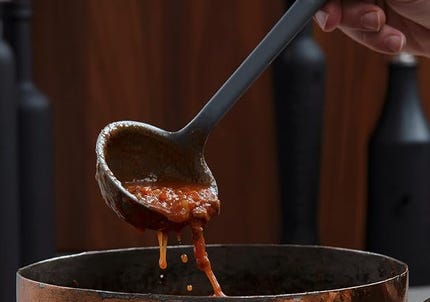
Spooning out a plate full of rice or pasta without a big ladle got annoying quickly. But the worst were beans: after cooking them, they’re this delightful brown slop and you either get the brown bean juice over everything, or you leave it behind, if you just scrape things out of the side of the pot.
So I bought a big ass ladle from the same company (GIR) that made my favorite spatula. It’s made from silicone and so should be heat resistant.
Cooking the lentils/beans
To my surprise, this has been the most annoying part so far. The reason is that you have to cook legumes for a really long time, and you typically don’t use that many in a single portion.
I quickly discovered that more than maybe 1/2 dry cup of beans/lentils would totally overpower the rice or pasta, and I needed to use less.
But cooking lentils on the stove takes about 45 minutes, and beans often over 2h!
You can pressure cook them, but pressure cookers like the Instant Pot aren’t made for 1 tiny portion, their pots are huge. Much bigger than I even use in my daily cooking for ALL my food!
So I decided to make a giant batch of beans, put them into ziploc bags, and freeze them.
I made a 5lbs bag of kidney beans in 2 big batches in the instant pot, which only takes “10 minutes” if you’ve soaked them overnight. I put the 10 minutes in quotes because the pot needs to build pressure, then cook 10 minutes, and then depressurize, so it’s really closer to 45 minutes. But you don’t need to be there to watch it, and it sure beats 2h.
At the time of this writing I am on the third of 6 quart-sized ziploc bags of beans. I add a little bit into my rice or pasta meal every night. They last a LONG time.
Flavor wise, I think I actually prefer the lentils.
Making bread
This is not the bread maker I’m using, but they don’t seem to make that one any more. My model makes smaller loaves, square ones. Just imagine the bread pan in the picture was only as long as it is wide.
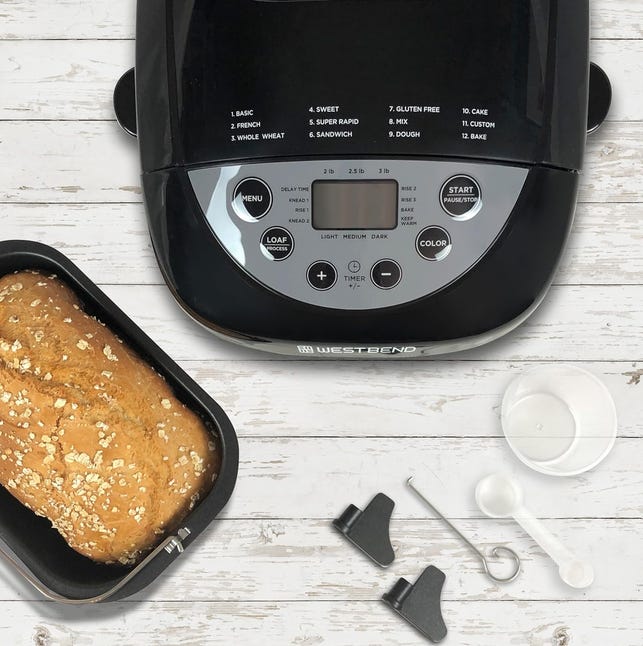
Using a break maker is super easy and hands off once you figure out a basic recipe you like. You toss the ingredients in, hit the start button, and walk away. 3h later, you liberate the bread from the machine and let it cool.
I got this machine from my friend who hadn’t used it in years. He also gave me a bread knife, which I didn’t have. You can cut bread with any knife, but the bread knife is, well, made for it.
I found that bread lends itself to playing around a lot. I started off with a pretty minimalist 4-ingredient recipe that only called for water, flour, yeast, and salt. Then I cut out the salt. Then I played around with cutting out the yeast.
The yeast makes the bread “rise” which just means it has more air bubbles. Same amount of bread in more space.. ridiculous!
It turns out that most recipes add enough yeast to make ridiculously fluffy & airy bread. I hate it. Why would you make bread that contains mostly air?! Just eat less real bread. I don’t like the spongy texture, how it breaks apart, and how it leaves you feeling like you should be satiated but aren’t.
You can make bread with absolutely no yeast in it and it still tastes great. The texture is extremely thick and dense, and you’ll eat 1 or 2 slices and feel super satiated. It takes forever to eat these slices, too, cause there’s so much bread in each of them. Imagine an entire loaf of bread in the size of a medium size bread roll. That’s how dense it is.
I’ve also played around with the water to flour ratio, and the types of flour. I tend to like a mix of white flour and whole grain flour. Neither pure white nor pure whole grain are bad, but the combination just seems to be my favorite. It’s more gray than brown, but it’s super thick and has a nice texture. I usually do 50/50. But sometimes I’ll use white flour or whole grain flour only, just to mix it up.
In terms of water to flour ratio, the initial recipe I found called for 1 1/2 cups of water to 4 cups of flour. I tried 5 and 6 cups, and seem to prefer the 1 1/2:5 ratio. Maybe I just prefer slightly drier bread. Sometimes the bread machine messes up the mixing process, and you get a somewhat unmixed mess of super dry vs. super chewy bread. It’s a monstrosity and I love it. I actually wish I could induce this on purpose. Maybe I should just try baking flour without mixing it properly, lol. Overall, though, the bread machine almost always gets it right.
My current recipe:
1 1/2 cup water
5 cups flour (half white/half whole grain)
Little to no yeast (I like thick, dense bread)
If you do use yeast, pay attention to the manual for your bread machine. Some require you to put in water first, then flour, and the yeast on top of the flour. Others, yeast directly into the water. This will make a big difference, as the yeast coming into contact with water will begin the chemical reaction to start rising your bread.
If you put yeast directly into water and the flour on top, in a bread maker programmed for the opposite, the yeast reaction will start way too early and it might be over by the time your machine gives it the “time to rise.” It’s still edible, but it’ll sort of look like and be a mess. If you don’t add any yeast, well, you don’t have to think about this.
And speaking of cups..
Measuring cup
I didn’t previously own a measuring cup, because I’d initially used a scale to weigh my ingredients on ex150, and then later just memorized it.
But for baking, all the recipes are in cups, not grams, and it’s just a lot more convenient than weighing.
I use both a pyrex measuring cup and one of those metal measuring cups.
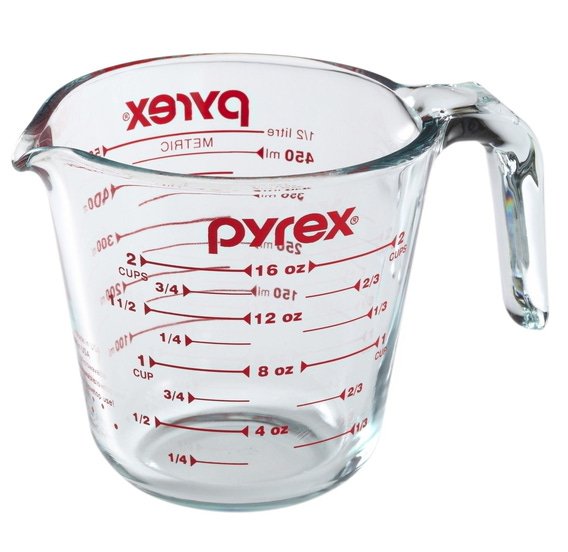
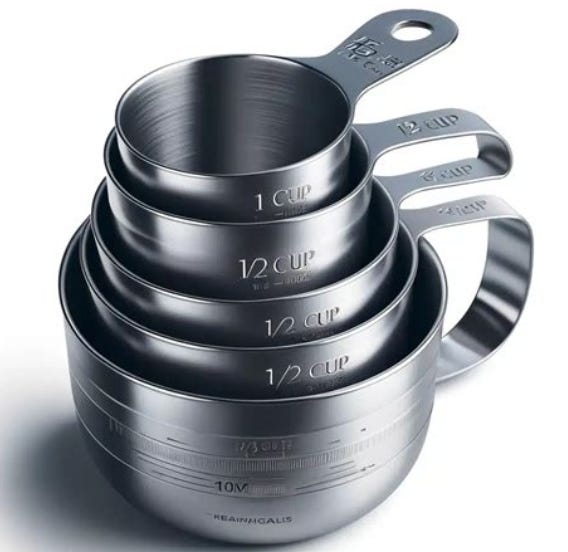
If you don’t know, when measuring flour you’re not supposed to shake or pack the flour as it’ll pack more densely and that’ll change the recipe. Take a heaped measuring cup, then use a flat object like a knife or your finger to scrape the top flat. Just scrape it back into the flour bag.
That’s it in terms of new stuff. Besides the break maker, none of these are essential, they just make it more convenient. (And even that one is optional if you count your regular oven.)
But if you’re pretty new to cooking with starches like me, and going all-in on relying on them for most of your day to day food, it sure helps to make the transition as easy and convenient as possible.
Update on ex150hclf
Day 27 of ex150hclf and it’s going.. pretty well! I’m getting very good satiety on the starch, and digestion is much better than anticipated.
I gained about 5lbs in the beginning, some of which was muscle glycogen as my muscles now look much fuller than on ex150. Some of it was probably digestive weight too.
My weight was very flat the entire time after that until I ate a social cheat meal that was heavily salted (steak & mashed potatoes), which made me gain 4lbs overnight. Hoping that’ll come off soon, as it’s probably just water retention from all the sodium? It’s also been very hot, which tends to make me gain (water, I think) weight. My body seems to want to hold on to more water when it’s hot.
Overall this is going much better than I thought:
I am not hungry every 2-4h like I was on plain rice, I can easily go all day and be physically active despite eating minimal or no food for breakfast
My weight is stable (at least for the longest time) despite eating massive amounts of starch, and I feel very strong satiety (not quite cement-truck satiety, but very good). This despite ex150hclf being much higher in protein than ex150, sort of a necessity with a starch-based diet, as starches usually contain 10% protein.
Digestion, which was a big worry for me, has given me zero problems
Whatever I thought was gluten or wheat’s fault in the past, must not be a problem now. I went Paleo at age 25 because I got such bad acid reflux I couldn’t fall asleep at night. Lying down would always give me insane, painful reflux. Now, nothing. I’m literally eating a loaf of bread a day. I don’t see how you could eat much more gluten than I am currently doing. I don’t know if it was seed oils the whole time (messing up my stomach lining?), or another ingredient in commercial bread (enrichment “vitamins?”), or the fact that I’m using organic flour means I’m avoiding some pesticides. But it’s working perfectly fine, like it did for most people most of the last 10,000 years since the agricultural revolution.
Wheat was framed!
The first month of ex150hclf just flew by no problem. It’s cheap, easy, and convenient, if not as cheap, easy & convenient as just drinking heavy cream.
At this rate I don’t see any problems going to the 3 month mark at least. I think I’ll still do a little swampy refeed after the 30 days, which shouldn’t affect the PUFA-depleting nature of HCLF much.
I am casual HcLf. I make a large vat of chicken stock with extra feet and necks in the pot. Sometimes kelp and a tea ball of seaweed. I make rice with the stock stove top in antiquated Corningware. That's my go to staple. I gets labs done pretty frequently and look at TG/HDL-C as a marker for insulin resistance. I low dose A GLP-1 to cool my shoulder arthritis. Avoiding seed oil for quite some time and eating mostly HcLf is working pretty well for me. I experimenting with a low dose of Pilates as well and am enjoying that. Keep rolling on my friend.
Nishiki....! Is it good?