
Insulin Resistance is a Useless Construct
On scientific myopia


There are a lot of people, many of them Ketards, who throw around the term “Insulin Resistance.” Some of them even hold PhDs, but nobody’s perfect.
I think the term is supremely useless most of the time because it doesn’t tell us anything we didn’t already know.
What IS insulin resistance?
In my opinion, the “X resistance” category of metabolic terms, like insulin and leptin resistance, is a way of trying to stick to a theory that has essentially been disproven.
A lot of low-carb people used to claim that carbs → high insulin → obesity. Similarly, when leptin was discovered and popular in the 90s, a lot of people hypothesized that lack of leptin kept obese people obese, because their body fat level was somehow not being detected correctly.
But then technology got better and we could actually test these things, and they were not true. Carbs didn’t necessarily lead to insanely high insulin levels, and overweight/obese people didn’t always have crazy high insulin levels.
And, in fact, most obese or overweight people had pretty much the leptin levels you’d expect, and injecting people with leptin doesn’t help 99.9% of them. (There is a tiny subcategory of people who don’t produce enough leptin, but it’s extremely rare. These people immediately lose weight when you inject them with leptin.)
You’d think that scientists, upon learning that insulin & leptin levels were not actually insanely dysregulated in obese people, would change their hypothesis.
But instead, they used a word game to keep claiming to be right. If insulin/leptin levels were actually reasonable, but the expected outcome wasn’t happening… there must be insulin/leptin resistance!
You can read Stephan Guyenet’s “The Hungry Brain” for a fascinating tale of how scientists fell in love with leptin, were proven wrong.. and just kept sticking to their story instead of changing their minds. (Hint: he’s one of them.)
Insulin resistance is defined as “for this level of insulin I expected your blood glucose to be this level, but it wasn’t.” Leptin resistance is defined as “for this level of leptin, I’d expect your appetite to be lower, but it wasn’t.”
They are literally defined by wrong expectations on the part of the people inventing these mathematical ratios.
Now, mathematical ratios are not necessarily useless. For example, we’d probably all agree that even if an obese person has the expected leptin levels, or a diabetic has the expected insulin levels, something is still wrong.
The issue is just that these terms don’t tell us any useful, new information. We already knew that diabetes and obesity are bad, and these terms are just rephrasing that in sciency-sounding word salad.
Analogy time!
Imagine you ran a sales department of door to door salesmen. Let’s say you’re selling… encyclopedias, I don’t know.
One year a lot of your sales guys come back from their long trips and report that they haven’t sold nearly as many books as previously, or as expected.
“Why?” you ask.
“Oh, there was sales resistance,” they answer.
Sales resistance means nothing. It just means you didn’t sell as much as you expected.
WHY did the good people of <insert flyover state> resist the sales of these fine encyclopedias? There could be any reason.
Maybe the quality of your books went down. Maybe the design went out of fashion. Maybe Wikipedia got invented and everybody’s using that now. Maybe people can’t read good any longer. Maybe they’re watching TV instead. Maybe your sales guys lost their edge. Maybe there’s a recession going on, and nobody can afford your premium quality books. Maybe crime has been going up and people are hesitant to open the door. Maybe your company sponsored a politically controversial figure because they hired some inexperienced, young marketing executive and alienated their entire customer base. Maybe there are celebrities on Youtube shooting your product with rifles. Maybe one of your sales guys is a sleazy scammer and has been ripping customers off, and word got out and now nobody trusts any of your sales reps.
We have no idea what is causing the decline in book sales. It would be great to know, so we could address it, but saying the word “book sales resistance” adds zero knowledge. It’s just literally rephrasing the problem: Lower than expected book sales → book sales resistance.
That’s what insulin resistance and leptin resistance are.
And on top of that.. is insulin resistance even bad?
The funny part is, there are actually clear mechanisms of what you could call “insulin resistance” in the body, and many of them are there for a purpose!
I recommend you read Jaromir Janda on various forms of Insulin Resistance to get a better picture, but let me just summarize it briefly.
Short term Insulin Resistance is the satiety signal
If your metabolism is running on glucose, then insulin’s job is to signal the body’s cells to uptake glucose for fuel. The cells see insulin, open the door, and let some glucose in to burn for energy.
But what happens once the cell has enough fuel? Cells don’t have infinite D&D “bags of holding” to store unlimited glucose. Excess glucose can actually be toxic to cells, which is why diabetes can kill you.
The cell therefore regulates how much it “listens” to that insulin signal. Think about it: if the ice cream truck comes through your neighborhood but you already have 7 gallons of ice cream in the fridge, your kids are currently eating ice cream from a bucket, and you couldn’t possibly use any more - are you going to open the door and let the ice cream man in? No!
Ice cream resistance.
But of course there’s a good reason you’re resisting the ice cream. You already have more than enough, it’d be a waste of money, it’d melt, it’d create a mess in your kitchen. You might lose your eyesight and legs.
In this sense, short-term insulin resistance is a very good thing, and some speculate that it is literally the satiety signal, the cells creating back pressure through insulin resistance to tell you that you’ve had enough to eat.
Medium term Insulin Resistance is a fat vs. glucose signal
In the medium term (hours to days), insulin resistance can be a signal that you’re in a fat-rich or carb-rich dietary environment.
Our metabolism can run pretty well on either fats or glucose, but each cell sort of has to “choose” which one to burn at any given time. Think of it like a dual fuel truck that can run either on diesel or on vegetable oil (yes, seed oils). You don’t just mix them willy-nilly, you have to switch between the tanks. Maybe one is better at freezing temperatures, or in the summer when it’s hot, due to the fuel’s properties. Maybe the engine idle speed or something else needs a little tweaking.
The way it works in the cell is the Randle Cycle. (It’s not really a cycle.) In a sort of momentum-based mechanism, a cell slightly prefers burning the same type of fuel (fat or glucose) that it has been burning previously. This happens in each individual cell, not for the whole body, and it’s more of a fader than an on/off switch. But of course all the cells in your body are fed from pretty much the same source, your blood stream, and the fuel substrates available in your blood therefore do have a systemic effect on what your cells are going to prefer.
If you eat mostly fat, your blood will contain lots of fat and not a ton of glucose, and your cells will switch to burning mostly fat (and maybe ketones). This all depends on the type of cell, too, but there will be a huge shift system wide.
And if your cells have been burning mostly fat for a while, they’ll slightly prefer that, and therefore they will uptake less glucose, and therefore - they are “insulin resistant.”
In that sense, yes, eating low-carb/keto makes you “insulin resistant.” But it’s not a bad thing, just like the acute satiety from eating lots of carbs in a glucose-based metabolism isn’t bad either.
It just lets your body know that you’re not that into carbs right now cause you’ve got plenty of fat to burn.
This phenomenon is the reason why some people on keto get huge glucose spikes when they do end up eating carbs, and sometimes even fail Oral Glucose Tolerance or Kraft tests, and it’s therefore recommended that you “carb up” for 3 days before the test by eating at least 150g of carbs each day.
Once they switch back to a carb based diet, their cells get used to burning glucose again, and the “insulin resistance” typically goes away.
The “bad” Insulin Resistance is probably caused by leaking, hypertrophic adipocytes
Now we’re getting to the meat: this is the “bad insulin resistance” that the people throwing the term around are actually talking about.
And of course there has to be a physical or biochemical mechanism for what’s causing it. And if you know the mechanism, you can investigate the root cause, and then you can come up with a solution for the problem.
But you can’t just say the word “insulin resistance” over and over and expect that to help.
My current favorite explanation for what causes long-term, pathological insulin resistance and therefore diabetes, contributing to obesity: damaged adipocytes (fat cells) created by excess linoleic acid.
Studies have looked at adipose tissue in obese and sick animals and humans, and they’ve discovered that the fat cells are literally damaged. There are so-called “crown-like structures” around them, created by macrophages trying to prevent the dying fat cells from poisoning their environment with toxic sludge.
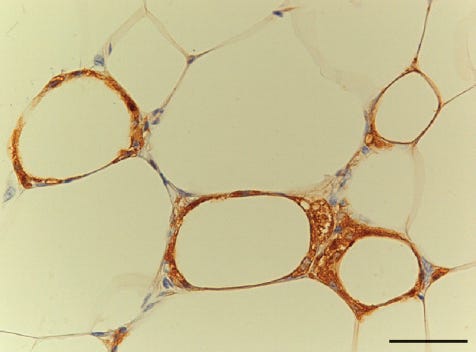
Fat cells made with excess linoleic acid seem to be unable to do their jobs, which is “keep the stored fat inside.” They are leaking and spewing their contents all over the place, which means your body can no longer regulate fuel consumption properly. It’s like a leaking gas tank, dripping flammable stuff all over the place.
The macrophages rush in to help and clean up, thereby forming these visible structures, which is how we can even identify the damaged/dead adipocytes under an electron microscope.
So there it is, our suspect for what causes “muh inSuLin rEsiStaNce.” And now that we know about it, we can start thinking about what causes it (eating too much linoleic acid?) and how we can fix it (stop eating so much linoleic acid).
But the word “insulin resistance” is not particularly helpful for any of that.
Conclusion

In summary, it’s easy to fool yourself by making up an accounting tautology, giving it an important-sounding name, and investing your entire identity or even career into it.
“Income resistance” can be found in every poor neighborhood or household in the world. “Right direction resistance” is common among drivers who get lost. “AC resistance” is common near open windows.
We can establish an infinite number of mathematical constructs like “insulin resistance” and “leptin resistance.” Sometimes they are useful, but they cannot be root causes because they are merely descriptive.
At some point, the buck of your theory has to stop someplace, and that place needs to be in physical & biochemical reality: WHY does someone have “insulin resistance” or “leptin resistance,” what caused it, and what can fix it?