
ex_bread+butter review: Visited swamp, did not explode, gained 8lbs
Aborted on day 11.


tl;dr: I ate bread for 11 days.
This one was a bit special. For one, I pretty much expected it to fail - in the sense that I wouldn’t lose any weight.
Second, mixing bread & butter is the first swamp experiment I’ve tried since I started seriously experimenting in late 2022.
Third, reintroducing bread, unlike other carbs like rice or sugar, sort of goes full circle to the beginnings of my dietary escapades.
It’s just bread, bro
As I wrote about in 19 Fat Loss Experiments I’ve Tried & Failed At, I started doing the Paleo diet in my early 20s because I had started getting debilitating acid reflux from eating bread, or wheat in general. I couldn’t sleep at night from the painful reflux, even elevating my head.
Paleo gurus were telling me that this was due to bread, or grain, or modern grain, or modern wheat in particular, being uniquely bad.
So I cut out the bread & most other grains and my reflux got much, much better. I’d say 90% less reflux. I went from being unable to fall asleep most nights to not having ANY issue most days, with maybe 1-2 very mild incidents a week.
I still noticed that lying on my side would cause issues more so than lying on my stomach or back, and that drinking lots of coffee on an empty stomach gave me acid reflux, as did lots of tomato sauce.
I could still eat rice, which gave me zero issues, and I ate low-carb-paleoish-but-with-rice for a while. This was great for the acid reflux, but did nothing for weight loss.
This was before I even did keto, so more than 10 years ago. Obviously my 10 years of keto involved eating near-zero amounts of bread and grains, including not eating any rice.
Over that time frame my acid reflux stayed roughly in the 90%-reduced range, maybe even getting a bit better over time. I remember still noticing the coffee & tomato issues about 5 years ago, when I had regained 100lbs while maintaining a strict keto & wheat free diet. But also it being basically a non-issue, just a bit annoying 1-2x a week.
Then I started ex150, my heavy cream diet, in late 2022. Besides immediately losing tons of fat effortlessly, it also improved my digestion & acid reflux from levels I considered “normal, fine” to 11/10 levels I did not know were possible.
I think I’ve had acid reflux… 1 time in the last year or so? And it was extremely mild. Barely an inconvenience.

Long story short, bread was more than “carbs” for me. Bread was the final boss of eating carbs, way worse than the rice I knew I tolerated well, or the sugar that I had tried as part of the honey or sugar diets.
Bread was the original reason I had given up carbs.. half my life ago. Wow. (I think I was around 22 when I went mostly Paleo.)
I have since stopped buying the Paleo argument as explained in my post RIP PALEO.
The evolutionary logic just doesn’t hold up, that’s not how genetics or evolution work. Also, sort of like the big hole in low-carb is “But what about Asians eating rice and being thin?” there was a pretty big hole in the anti-bread/grain argument: The entirety of Western Civilization ate a high-grain, mostly-bread diet for most of the last 2,000 years or longer.
My grandparents had eaten bread for nearly every meal their entire lives. My parents had eaten bread for nearly every meal their entire lives.
Heck, I PERSONALLY had eaten bread (or cereal, but those are also grains) for nearly every meal my entire life until my 20s. There were many days on which I ate entire loaves of bread as a teenager, and it was mostly fine.
So how did I develop a huge bread/grain/wheat intolerance in my late teens or early 20s, to a food that’s been a staple of my dietary culture forever?
Enter UK Bread Lady
As I’ve gotten more into Modern PUFA Theory (MPT) the last 2 years and started experimenting with carbs, I noticed that my lifelong Non-24 sleep/wake disorder was gone. For the first time in my life, I could eat carbs and keep a stable sleep rhythm. This had been one of the big reasons that I kept at keto for 10 years even after regaining 100lbs on it.
In fact, people ask me to this day why I stuck with keto for years after regaining 100lbs, instead of trying something else.
Dude, not being able to sleep is WAY worse than being morbidly obese. Easy choice.
Anyway, my newfound ability to tolerate crabohydrates led me to experiment with the honey diet, sugar diet, rice diets, .. so much freedom! None of these worked anywhere near as well as my 90% fat, super ketogenic heavy cream diet. But they also didn’t totally wreck me (except the sugar diet lol). I stayed weight stable on the honey diet & rice with tomato sauce. I even lost quite a bit of weight on plain rice!
My confidence in my ability to tolerate The Devil’s Macro slowly built up, and I was eager to read a series of posts on the subreddit r/PlasticObesity, an offshoot of r/SaturatedFat.
The subreddit is mostly about the introduction of plastics & plasticizers into our food supply, but prolific redditor Extension_Band_8138 there wrote a phenomenal series on the history of Real Bread (tm) and how bread has been bastardized into the absurdity we see on our grocery shelves today.
I highly recommend her entire series The Story of Bread:
In short: bread, maybe because it’s been such a staple of Western civilization, and is a much more complex product compared to e.g. rice, has been adulterated to a degree that few other foods have.
You could argue that bread was the original “ultra-processed food”: even in The Olden Days, it involved lots of physical milling, various ingredients, relatively complex mixing, leavening, and baking procedures and techniques.
Modern bread might somewhat look like real bread (tm), but the grains, the milling processes, the storage, the pesticides, the ingredients, duration, and mixing/rising/baking techniques have all fundamentally changed.
Let me quote Wikipedia on bread:
The Chorleywood bread process was developed in 1961; it uses the intense mechanical working of dough to dramatically reduce the fermentation period and the time taken to produce a loaf. The process, whose high-energy mixing allows for the use of grain with a lower protein content, is now widely used around the world in large factories. As a result, bread can be produced very quickly and at low costs to the manufacturer and the consumer. However, there has been some criticism of the effect on nutritional value.
This industrial process, invented in 1961, quickly replaced nearly all commercial bread around the world (or at least in the West). Traditional bread that your grandmother would’ve bought from the local baker was replaced with an industrial product that was cheap, easy to make in high quantities, did not go stale as quickly & therefore lasted longer on shelves.
Consequences would never be the same.
These bread posts really inspired me to try some Real Bread (tm), now that I could eat carbs. I even fantasized about buying my own counter top stone mill, purchasing organic (=non-fortified, non-glyphosate) grains, and baking my own daily bread from that.
The bread of my childhood had not all been traditional, Real Bread (tm). But my mom had gotten into baking her own bread for a couple of years, and I remember my grandma baking a lot, too. There had been a very nifty artisanal-style bakery not too far from where I grew up, and I remember it fondly.
Maybe my problems with bread started developing when I moved out and unknowingly started buying commercial chorleywood bread made with soybean oil, fortified with who knows what, sprayed & dried with glyphosate?
The timing also lined up pretty well: if this process was invented in 1961, and all these things presumably got worse over the last 20 years, it would make sense that I tolerated bread better in the first half of my life than the last.
Hole Bread?
For my experiment I obviously only considered artisanal, non-fortified, non-seed oil bread. So I found an artisanal bakery that sold bread made without any oils, with organic flour, non-fortified, no glyphosate. They even used traditional methods of baking, which take way longer than the industrial chorleywood method.
You know, the type of baker who gets up at midnight so the bread will be ready, crusty & warm & still gooey on the inside, when you get to the bakery at 8am.
I actually did go pretty early a few days, and the bread was indeed 1. still warm and 2. still gooey on the inside. Manna from heaven!
The bread looked, felt, and tasted completely different. Even commercial “brown bread” or “whole grain bread” is basically a scam. Compare these pictures from Wikipedia:
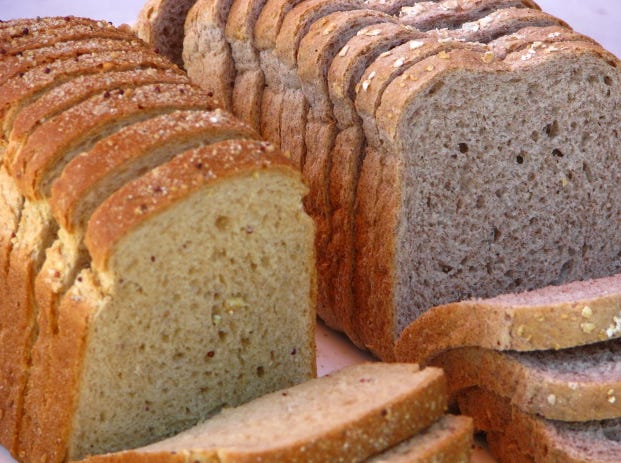
This is “brown bread” or “whole grain bread” but it looks exactly the same as Wonderbread.. it’s just.. brown. They sprinkled 3 poppy seed over every slice or some oats, but you can tell just by looking at it that is has the consistency of a sponge.
Now look at this:
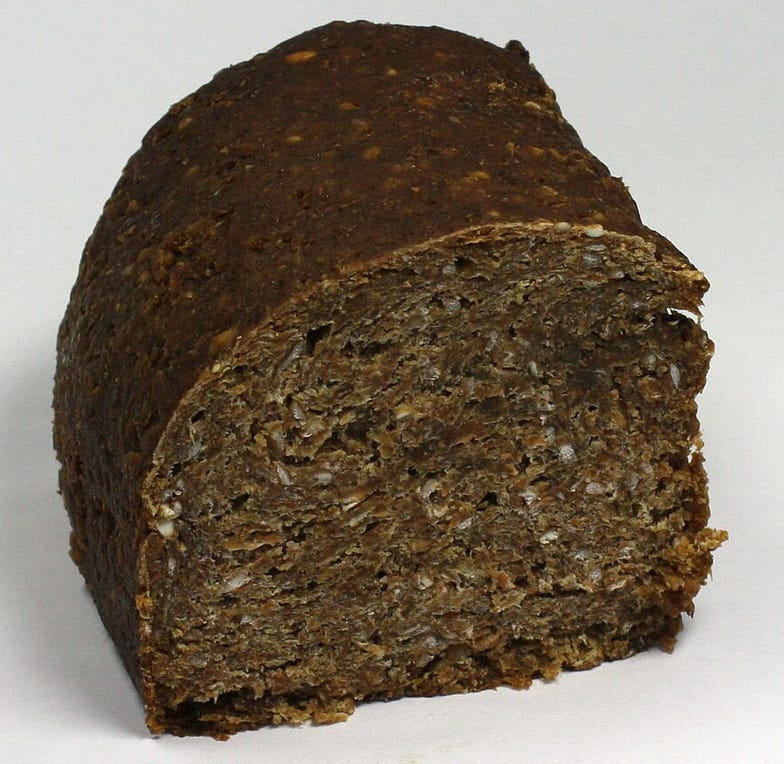
By God. It LOOKS solid. You can see it has the consistency of an oven-fired brick. This sort of bread counts as a lethal weapon in 23 states. Not just are the grains in it whole, you can probably find a whole field mouse in there.
This bakery had wheat bread, but they also carried lots of other grains: rye, spelt, barley, oat, millet, probably more that I’ve never heard of.
Even their “white bread” was a dark grey color at best.
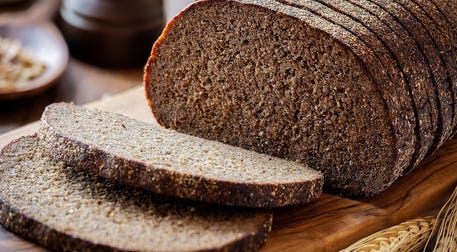
Besides the non-uniform appearance in shape and color, the biggest giveaway was the texture. You couldn’t compress these loaves like a sponge, like you can even with “whole grain” Chorleywood bread.
These loaves were thick like bricks. The slices were full and not very airy, unlike most commercial bread.
The bread would also go stale incredibly quickly. I’m talking same day. If I bought a loaf in the morning, it’d be noticeably stale by that same evening. The next morning, it was definitely still edible, but would taste quite dry and stale.
This is probably due to the lack of soybean oil, which they mix into commercial Chorleywood bread to prevent it from going stale on the shelves.
I think the longest I had a loaf sitting around was 2 days, and by that time, you basically had to dunk it in coffee to get it down. Which I did.
Rules of the Game
My rules were simple:
I could only eat fancy, artisanal bread and butter
I could eat it ad libitum
I could drink coffee with cream until 3pm
I could drink non-caloric energy drinks & diet soda (because reasons)
Oh, yea, I would continue to take the apple cider vinegar capsules I’ve been taking for a couple of months now.
Because bread usually contains some salt anyway, I didn’t particularly limit salt for this experiment. I obviously also didn’t pour any salt onto my bread, but I sometimes used salted butter when available, and I drank some Monster energy drinks, which are relatively high in sodium.
Not having had any bread in over a decade, I wasn’t sure what to expect in terms of: how much bread + butter would I eat, intuitively, eating to satiety? How would satiety work with bread and butter?
This was also my first foray into the metabolic swamp of carbs + fat in years.. how would I fare?
And what happened?
Pretty quickly I established the following:
Eating ad-lib, I would eat about 1.5 loaves per day on average. Of course this depended on the very irregular size of the artisanal loaves. Some types of bread were also much thicker/heavier than others.
A pound of bread is estimated to have about 1,300kcal, so 1.5 loaves per day is just under 2,000kcal. But, of course, I was eating that with lots of butter and drinking coffee with heavy cream on top.
I went through more than half a brick of butter per day on average, which is another 900kcal at least.
I would get both full & satiated on bread+butter eventually, but it would take quite a lot of bread and a surprising amount of carolies.
It was VERY easy to overeat. Bread is DELICIOUS, especially fancy, artisanal, fresh, warm bread with a hard crust and a gooey center. Add butter on top.. oh my.
I would EASILY eat 1,000-1,500kcal in one sitting before I would get any satiety.
Compared to heavy cream on ex150, the satiety came on very slowly and subtly. It was very easy to overeat and ignore the satiety signal. There would eventually be a “hard stop” feeling, but I would estimate it took over 2,000kcal in a single sitting before I would get a strong stop signal at all.
Despite commonly eating 1,500-2,000kcal in a single sitting, I would be quite hungry again only 4-6h later. I would say that satiety lasted longer than on white rice (2-4h), but rarely longer than 6h. Even if I ate a giant meal of bread+butter right before bed, I’d be very hungry in the morning, 8-9h later.
It was very easy to make myself sick this way, because the gap between “I could stop eating” and “I couldn’t continue eating” was so wide. On ex150, they are one and the same: I get hit with satiety onset so rapidly I dubbed it “cement-truck satiety.” With plain rice, I could only eat so much because it’s so low in energy density - by the time I was getting any amount of serious energy, I was physically filled to the brim - even if that only lasted 2-4h. But on this, it was sort of the worst of both worlds: I could eat insane amounts of carolies, the satiety would come very slowly and permit me to overeat by 100% or more, and then would still only last a few hours (4-6h).
Curiously, I noticed that I would get “butter satiety” before “bread satiety” almost every time. I would still be hungry, but unable to stomach any more bread with butter. First I got really confused, then I realized.. I could just eat dry bread? So I did that. Typically, I would eat 1-2 slices of dry bread once I hit the “butter satiety” feeling. The butter satiety felt a lot like cement-truck satiety - a slight nausea. Yet, curiously, I would still be hungry in general/for something else!
As expected from this satiety dynamic, I gained weight. That said, I didn’t gain nearly as much as expected! More on this later.
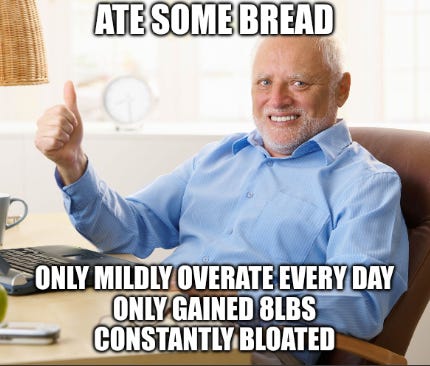
I also did not get ANY acid reflux the entire time. My digestion certainly wasn’t as good as on the heavy cream diet: a constant feeling of bloat, similar to the rice diet. Pretty uncomfortable, even though I sort of got used to it.
I also got pretty gassy, which was annoying. I get gas so infrequently on the heavy cream diet that it’s pretty much non-existent. With the bread.. let’s just say I was my own worst enemy.
To reiterate, ZERO ACID REFLUX or anything of the sort. Now I only lasted 11 days, but still! With bread being the Final Boss that made me go Paleo in chapter 1 (before the title screen), I was sort of shocked-but-also-not by this. Clearly, my recent experience had primed me to assume Bread (tm) wasn’t actually inherently the problem, it must be something about modern, commercial bread.
I don’t know if it’s the added soybean oil, the glyphosate on the grains, the fortification with random chemicals, the Chorleywood process or roller milling itself, or what.. but whatever made me give up bread, this fancy, artisanal bread did not seem to induce the same effect. At least not in 11 days.
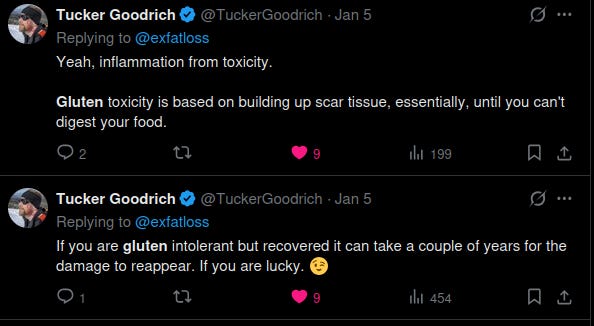
Although Tucker Goodrich, who is gluten intolerant, says that the real gluten damage builds up over years. It could be that I just got better in 1.5 decades of eating practically none, and that the damage would come back if I went back to eating bread for years.
Occasional cheating & quitting
I did find myself cheating quite a bit. The fancy artisanal bakery also had fancy, artisanal pastries, and I’d get one every other day or so toward the end of the experiment. I also bought & ate chocolate several times.
On day 10, at the store, I found myself buying (single-ingredient) pasta and (single-ingredient) tomato sauce and making pasta + butter + tomato sauce for dinner. Pasta is basically bread, right?!
It seems that I find myself cheating quite a bit more since discovering that I can eat carbs; many swampy foods are pretty good for cheating, whereas before I had made myself sick of steak & beef jerky in a decade of keto.
Since I no longer believe that carbs do lasting damage to me, maybe that helps - worst case it sets back weight loss a bit. I am still quite aggressive on avoiding seed oils, though. Interesting how the mindset/belief in what constitutes “healthy” makes it easy/hard to have “willpower.”
I am also finding that I have a much harder time sticking to a diet that’s not working anyway. If I lose tons of weight, it’s easy & fun to be strict - but if I’m already not feeling great and gaining weight, that doesn’t exactly motivate me to be strict.
At the beginning I had set myself a limit of how much weight I’d be willing to gain before quitting. That limit was 230lbs.
I did actually wake up just over 230lbs once, about halfway through the experiment, but it was weirdly up from the previous day and felt like a fluke. And it went back down to 223lbs the next day.
Overall my weight fluctuated a lot from day to day on this diet. But after clocking 229, 228, and 231 on 3 subsequent days, I decided to call it quits on day 11.
The fancy, artisanal bread tasted great, but not great enough to continue.
Tale of the Tape
Ok, so we’ve established that:
I can eat bread for a bit and be sort of fine
But I am bloated and digestion is sub-optimal
And satiety is lacking/fleeting
That doesn’t sound great for fat loss, does it?
For context, this experiment came AFTER a 3 day refeed that already included bread & carbs and was also high in protein - so this isn’t just water weight after a fast. Of course, some of it will be.
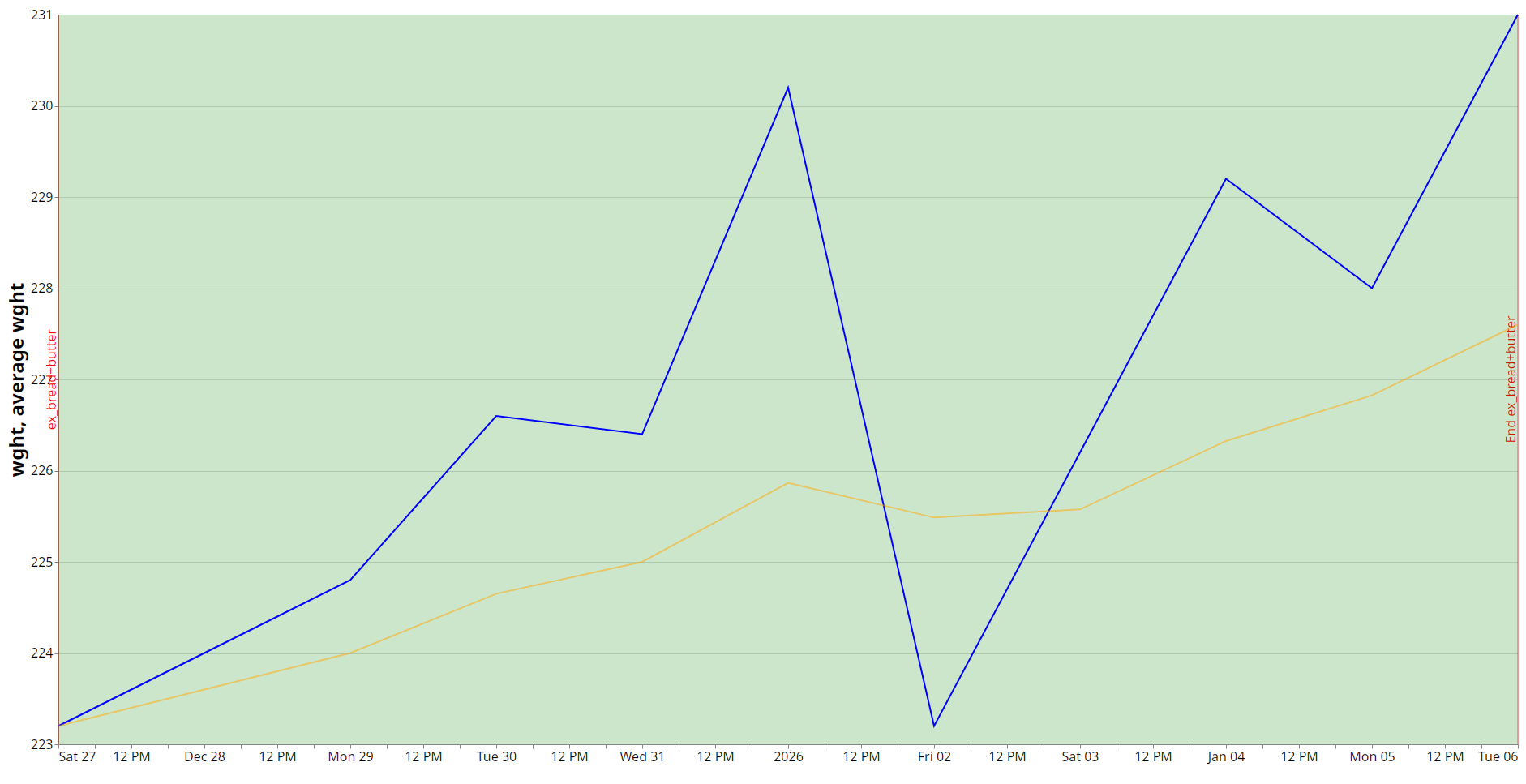
Up and to the right! Overall I am actually surprised by how mild the weight gain was. While I felt satiety was fleeting and relatively weak, I did reach it. I was never as hyperphagic as I am on my average protein refeed. I’d say I was about 20-30% as hyperphagic; it felt like I was constantly yet mildly overeating. With some roast beef or cheese on top, I probably would’ve eaten twice as much.
I gained 8lbs in 11 days, although some of that would’ve been just food residue & water weight even after a refeed. 11 days is also relatively short for an experiment to see a clear trend, and 7-pound spikes/drops from one day to the next aren’t exactly helpful. But hey, it wasn’t like everything else about the diet was going amazing.
So.. don’t swamp?
It sure seems like I did not do well on first contact with The Swamp. It’s hard to exactly pinpoint the macros, what with the irregular numbers in artisanal bread and the fact that I didn’t actually weigh everything exactly. Protein content of different flours also seems to vary quite a bit.
But here’s an estimate:
2lb (908g) of bread per day
half a brick (125g) of butter per day
Macros therefore: 139g fat (38%), 431g carbs (51%), 97g protein (11%)
This is where that places me on the Swamp visualizer:
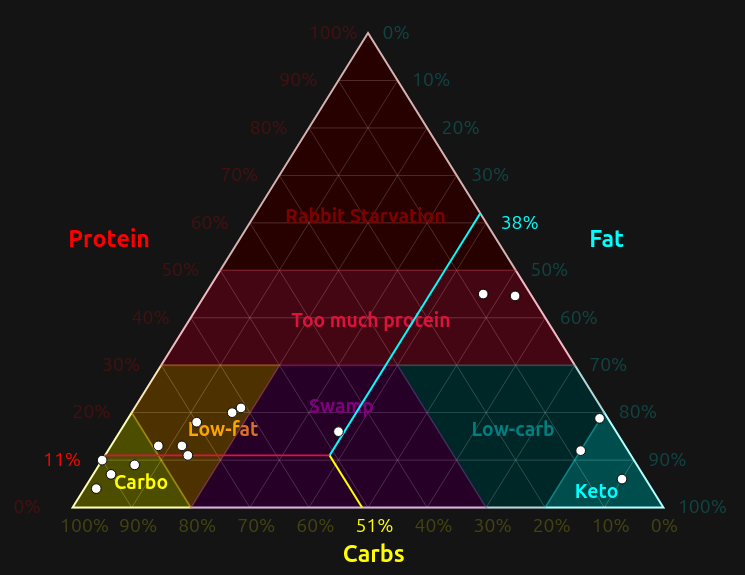
Now 11% of protein is not particularly low; usually, I’m at around 6%. My total protein actually more than doubled on this diet from ~40-45g to ~97g/day.
Otherwise, this is pretty solidly in the swamp, near the middle. It seems that it’s much more difficult to approach the 50/50 of carbs/fat when swamping; even as a 1 decade ketard I found it hard to eat more butter or cream on this diet, whereas more dry bread was always possible.
When doing keto, of course, I don’t have that problem: I can pretty easily go to 90% total fat, and even approach 94-95% or so. But when my body is not in keto mode, even 40% fat is quickly unpalatable.
This is probably why you see the SAD at 37% fat, nearly the exact percentage (38%) I had. That’s probably just about as high-fat as you can make a mixed diet and still have people eat it voluntarily. That’s all your starch saturated with fat to the limit.
It therefore seems that, even when swamping, it’s difficult to get the protein low enough. The particular bread entry I picked from the USDA database happened to have 15.6% kcals from protein, nearly 3x my ex150 percentage. I think that’s quite high for bread, but honestly I don’t know how much protein was in the flour my bakery used. The lower limit I’ve seen in breads is 10-12%, it’s among the higher-protein starch staples.
There are therefore at least 3 hypotheses that jump out at me as to why I gained weight (if somewhat slowly) eating bread+butter:
Protein was still too high at just over 2x my normal amount, though not high enough to trigger super acute hyperphagia, like I see on my protein refeeds
I can’t swamp (yet?), period
Bread per se is cursed (let’s say for reasons other than protein)
I could try other starches for the swamping, e.g. tallow fried rice balls or creamy rice. Or I could try and find a way to get the protein down to 6%.
But for now, I think I’m ok. I’ll probably test the swamp again some time later.
Superhyperphagilisticexpialidocious
I can’t stress enough how mild the overeating was on this. When I do my usual refeeds, even when they were just steak/ad lib beef/cheese/eggs, I would go into an insane hyperphagic frenzy. I would eat way more, way more quickly, and I would get way more of a “dopamine” (if that’s what it is) hit.
Then I would feel way more sick. I’d also gain weight faster, I’d say I’ve seen about 2x the rate of weight gain I’ve seen here when doing ad-lib protein.
So while the bread + butter swamp certainly didn’t “work” it also wasn’t nearly as bad as other “normal” diets.
Notes
As always I took a bunch of notes. Here’s a selection:
Satiety
Day 1
Got to satiety surprisingly quick, given I ate high-protein refeed just the previous day
Bread with butter spread on it, coffee w/ heavy cream
Hits well, not quite cement-truck satiety but the probably more normal “full & satiated & comfy warm” feeling that I don’t usually get with “normal” meals
Had to stop eating despite wanting to continue
Was able (not “hungry”) to eat again 2h later, but only a few slices & 1 coffee until I hit a hard limit againDay 2
Breakfast typically biggest meal, eating half a loaf of bread w/ lots of butter
Lasts 2h or so, then I could eat again, but only a few slices or a coffee
Typically I seem to “run out of butter appetite” before I “run out of bread appetite” so I’ll eat a dry slice or 2 towards the end before I stopDay 4
Much easier to overeat than either ex150 or plain rice. More akin to tomato sauce rice; where it just tastes good even if you’re already satiated.
5h after a big breakfast... I COULD eat, but I’m not.. hungry?Day 9
Kind of annoying: no matter how much I eat on this, I’m hungry again 4-6h later
I think I regularly eat 1,500-2,000kcal in one sitting and am hungry again 4h laterDigestion
Digestion surprisingly good, had sort of expected more adaptation
Kind of gassy today
There’s one note that specifically compares satiety on bread+butter vs. ex150 vs. rice, which I thought was interesting:
Interesting to compare “satiety” vs. “appetite” along ex150, bread+butter, and plainrice
ex150 is highly satiating + very low appetite, plainrice is very low appetite but it quickly comes back, this [bread+butter] is sort of a wider gap between the 2 - I could eat again after 2h (”lack of satiety?”) but I’m not particularly hungry or “have an appetite” - but when I do [try to eat], I can!
Probably requires more planning or “willpower” to undereat on this? Whereas ex150 pretty much leaves you no choice, and neither does plainrice (because you’re immediately hungry again ~2-4h later)
Compare: protein hyperphagia, which is satiety but still insanely strong & acute appetite/hunger
8pm: I haven’t eaten in .. 5-6h? I am not HUNGRY per se, in that I am fine sitting here and not going to the kitchen. But also if you put bread + butter in front of me right now, I would easily eat 1,000kcal, I just know it.
Very different from cement-truck satiety. The 2 curves of satiety & appetite are just wide apart. K-shaped satiety lol?
Prediction: I will have gained 10lbs by 14 days and will quit lol
These differences in the various parts or dimensions of “satiety” are pretty interesting and I have to think about it some more. It’s really not as simple as “satiety is when you’re not hungry.”
Conclusion
Hey, I ate a bread and I didn’t explode! This trial actually went much better than it could’ve. Of course it’s hard to disambiguate if this was the swamp aspect, or the bread aspect, but my digestion was “sort of fine” yet suboptimal, just like with the rice.
Unlike the (low-fat) rice diet, I actually gained weight, but then again I sort of expected that.
Honestly, eating really nice artisanal bread after 1.5 decades was great. And the fact that I do ok on it, if not spectacular, was great too. Maybe I’d develop acid reflux and other issues again if I kept eating bread for years. But at least in the short term, Real Bread (tm) wasn’t nearly as bad as I remember (mostly commercial/modern industrial) bread being.
After having some Real Bread (tm) I don’t know if I’ll ever eat that crappy off-the-shelf bread again. The difference in taste & texture is just night and day. Compared to e.g. heavy cream or white rice, the quality of bread makes a HUGE difference. I could barely tell you the difference between the best & worst rice I’ve ever had, but for bread, it goes from “holy crap, this nonsense is INEDIBLE unless you toast it & drown it in coffee” to “this is Manna from the Heavens, how can anything taste so good?!”
It certainly was a fun & silly short experiment to try, and now I feel ready to just do the same old thing that worked last time - coming up, of course, is ex150nosauce+ACV-3. At the very least, I hope to yo-yo off the 8lbs I just gained, lol.
Exciting, sure sounds like you're getting better!
Weight gain from higher protein (1kg/week is roughly what I get too)?
Gas from fermentation (but why? and why not from other starches?)
Acid reflux Christ knows (fermentation? h.pylori? (in which case get that fixed, it's bad news, antibiotics should kill it.))
I'm so glad that you finally tried the swamp! Very interesting results, the notes on the different types of satiety are really interesting.