
If it was just linoleic acid depletion..
The Null Hypothesis


If you’ve read this blog for a while, you’re probably aware of my main hypothesis for the obesity epidemic: linoleic acid, the omega-6 polyunsaturated fat found in seed oils.
Seed oils explain the Mysteries of Obesity.
One of the most insidious facts of this Modern PUFA Theory (MPT) is that fats get stored in our body. Even if you stop eating seed oils today, it would take an estimated 4-8 years until the levels in your body fat returned back to healthy levels.
This makes the hypothesis very difficult to test: we can’t just put people on a low-PUFA diet for 2 weeks and see if they lose weight. While many do, the real effect would take years to be observed. That’s simply not feasible for RCTs or most other studies.
But it can be done by Citizen Scientists like you and me. I’m about 3 years into a low-PUFA diet. I probably started pretty high, given that I was eating a very high fat Standard American Keto (SAK) diet full of bacon, fatty chicken, salad dressings made from soybean oil, nuts, and the like.
When we look at my weight since I began eating low-PUFA, we can see that I lost a drastic amount of weight in the first few months, and then the weight loss started slowing down:
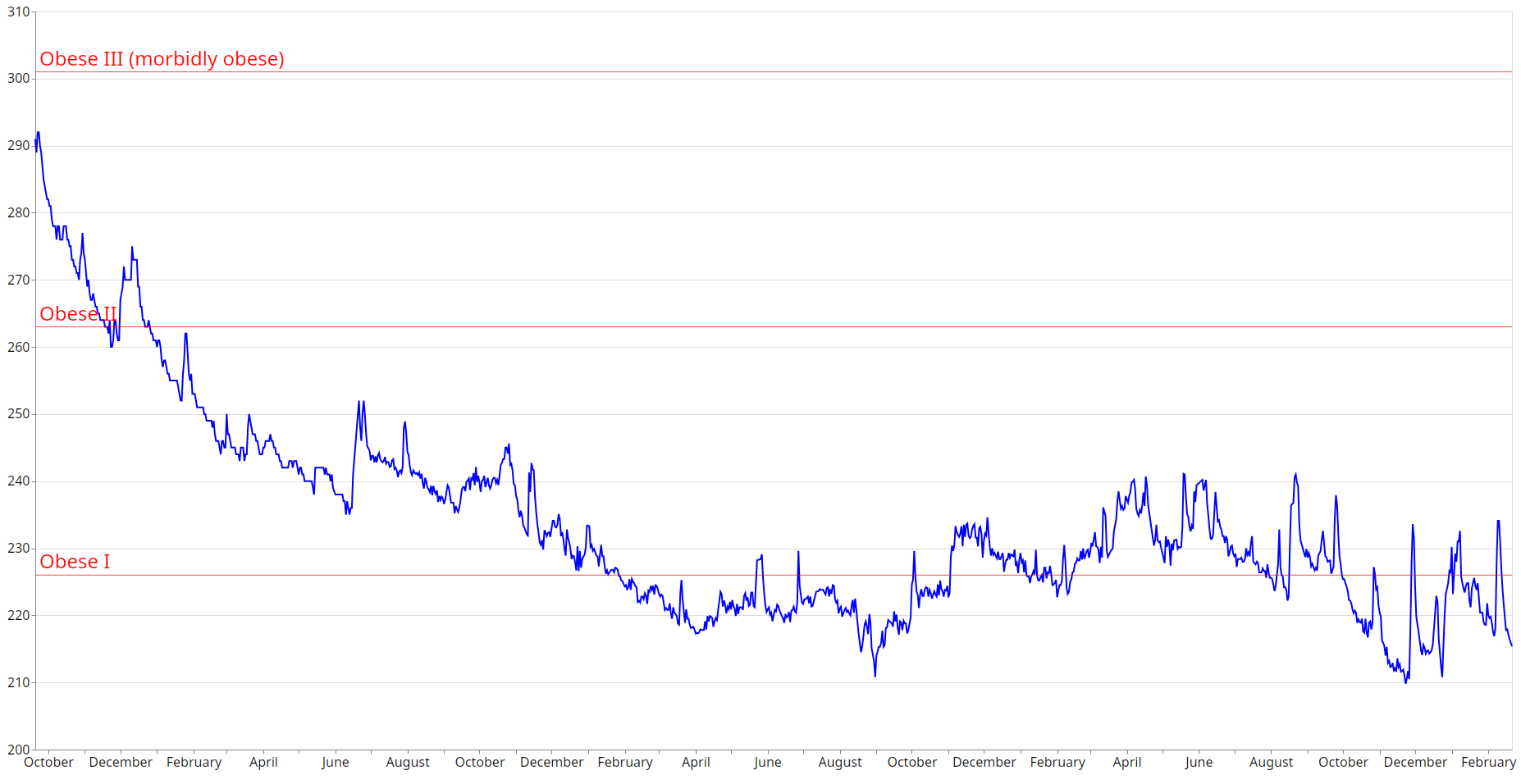
Once I began stalling for months at a time, I began experimenting with various diets besides my heavy cream staple diet: I tried rice diets, fish diets, chocolate diets, sugar diets, exercise, and many more things. Some of these led me to new low weights. Only recently I discovered supplemental vinegar and removing excess salt and glutamate from my diet (e.g. no tomato sauce or mushrooms).
And again, I hit a new low weight.
But what if all of this didn’t matter, and I just slowly lowered the linoleic acid content of my adipose tissue? What if I’ll spontaneously lose weight slowly & hit new low weights as I continue to eat low-PUFA, totally independent of all the high carb, fasting, vinegar, salt, or glutamate experiments?
It’s hard to test, since I can’t exactly A/B test 8 years of low-PUFA with and without these experiments..
Shiny New Experiments Keep Me Entertained
Even if we can’t disambiguate the two hypotheses easily, my experimentation while keeping PUFA intake low is probably just fine.
If anything, experimenting inside the low-PUFA paradigm keeps me motivated, entertained, and doesn’t make the diet too boring.
After all, I discovered I can eat carbs again without bringing my Non-24 circadian rhythm condition back. I discovered I can eat a 90% carb, low-fat rice diet and do just fine on it. There’s quite a bit of flexibility in the low-PUFA dietary spectrum, which makes sense: it used to be nearly all food eaten by humans was low-PUFA, with small, usually seasonally or geographically restricted exceptions like nuts (seasonal) or sesame paste (geographic restriction).
Most humans, for most of human history, ate a very low amount of linoleic acid on average. That’s why most humans used to be a healthy weight and possessed a healthy metabolism.
If one had to eat exactly 1 specific diet, e.g. ONLY white rice or ONLY heavy cream for 4-8 years, that would be a tough sell. But if there’s lots of room within the MPT paradigm for high fat, low fat, starch based, sugar based, low protein and high protein diets of all combinations, that’s great news!
Projection
My current goal is to just ride the ex150nosauce+ACV train and see how low it can go. I did reach a new low of 209.8lbs just 3 months ago on this diet, and so far (this month) the same thing is working very well, although I am not quite back down to that level yet (215lbs this morning).
I’m somewhat committed to just spamming ex150nosauce+ACV until it stops working, meaning an entire month, pretty strict, with zero weight loss.
But maybe that’ll just bottom out around the 209lbs mark until I seriously deplete more linoleic acid? In which case we would expect to see eventual, slow weight loss, not from the nosauce or vinegar, but simply from continuing to eat low-PUFA for years.

In the “it’s just linoleic acid” universe, I would only very slowly lose more weight beyond maybe the recent 209lbs low. It would take years to deplete my adipose tissue of it, and weight loss would only occur according to the level of LA depletion. LA depletion might or might not show up on OmegaQuant Complete tests. They are a pretty blunt instrument, and it might take years to see a change on there.
In the “nosauce+ACV is actually doing something” (call it the.. additive model maybe?) I would continue losing fat more rapidly, maybe relatively linearly. I should therefore keep reaching new lows pretty much every month I do this, presumably until I reach a certain body fat % and body weight, say 15-20% bf at around 180-190lbs or so.
I think I can pretty easily continue what I’m doing right now, ex150nosauce+ACV with monthly refeeds and the occasional social cheat meal.
That means we should know in a few months. I should hopefully reach the 209lbs low this month or early next month. If I’m at 200-205lbs after next month, and break through the 200lbs within 2-3 months of doing this, that’d be a pretty clear signal. (Whoa, I just realized that “signal” contains the word “sign” lol I am retarded.)

Interested in how this goes. I'm biased to have simplicity - just linoleic acid - to win by 90% or more here.
Also, it seems that a keto diet with moderate amounts of pufa(evoo, eggs, avocado, fish, occasional nuts and chicken...) doesn't accumulate much pufa in the fat cells, especially if you're already lean(Nick Norwitz, Raobb Wolf or Peter Dobromylskiy in his early keto years). Pufas are treated by the body more or less like mcts. Chucked into the ketone furnace. Obesity probably changes things. Most importantly, such a diet doesn't deplete linoleic acid already in the fat cells as efficiently.
I think it is very reasonable to accept that there are factors other than pufa consumption which interact with pufa consumption, e.g. plastics, artificial light etc.
An analogy: asbestos alone is pretty bad, but what really cranks up the lung cancer is asbestos + smoking. Either factor alone is nowhere near as bad as both together.