
A Closer Look at the 2026 U.S. Food Guidelines
RFK Jr. dodges a bullet..

RFK Jr. and some other people just released the new U.S. Food Guidelines. These are apparently typically released every 5 years. E.g. the last edition is from 2020 and titled 2020-2025:
The new edition, just released, is therefore valid from 2026-2030 and is available at https://cdn.realfood.gov/DGA.pdf. You can get a little slideshow preview at realfood.gov.
Media Splash and “Experts”
After the release, there was a big media splash. Unfortunately, since RFK Jr. is considered a “very controversial figure” most of the reports didn’t seem particularly objective. You already knew if you liked or hated him, and the opinions on his changed guidelines pretty much followed party lines.
Which is kind of wild, given that you’d think health & nutrition would be a common problem or common cause.
The critiques the new guidelines were sort of funny. Kind of like when talking with vegans, I find myself agreeing with part of what they’re saying for mostly different reasons, and still being misaligned for 90% of recommendation.
For example, many critiques involved pushing back against RFK Jr.’s recommendation to increase protein, e.g. from animal sources.
I am on record as saying Please Eat Less Protein and have been on a heavily protein-restricted diet for 3 years now. I think a lot of people (maybe 30%?) can benefit a lot from protein restriction.
That said, all the articles by “experts” that I see criticizing protein increases in the new guidelines warned that red meat comes with saturated fat and cholesterol, and will clog your arteries and give you heart attacks. Of course I massively disagree with that. In my own diet, I replaced the protein from red meat with.. heavy cream, aka more saturated fat.
The entire field of “experts” in nutrition doesn’t agree on almost anything, and what they agree on is largely wrong in my view.
My dietary views are influenced by a decade of keto, and before that, 5 years of paleo. The last 3 years, I’ve also gotten heavily into the seed oil debate and less common things like protein restriction.
I therefore don’t fit into any mainstream camp well, and pretty much any diet opinion is going to be orthogonal to me, be it from experts or not.
My Opinion: The new Guidelines are Mostly Great
Both in terms of the big talking points and most of the details, I think the new guidelines are a huge improvement. This is the first thing you see when you visit realfood.gov:
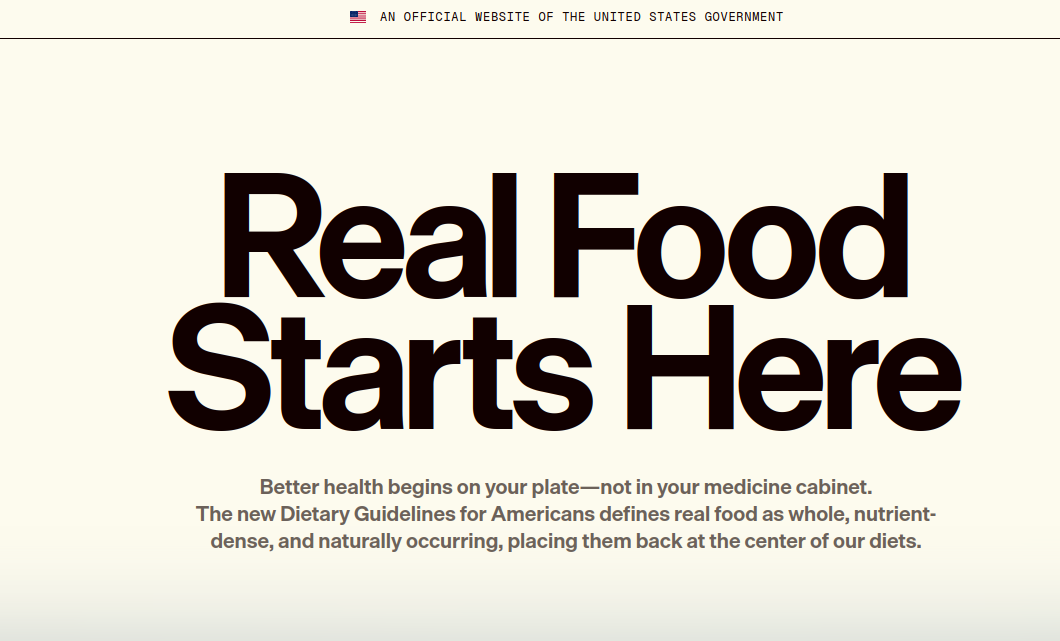
Now I’m on the record making fun of “real food” and “ultra-processed food.” But we’re talking about very broad guidelines for the entire population here, not trying to pinpoint the exact cause of obesity.
One of my main points against the “real food vs. UPF” dichotomy is that I regained 100lbs eating a keto diet of 95% “real, whole foods.” And I didn’t lose any weight when first going paleo.
In short, I think that “processing” doesn’t mean much, and there are many highly “processed” foods that are fine, and many mostly unprocessed foods that contribute to disease and obesity.
With that said, I do think that reducing the amount of what is currently on the market as “ultra-processed food” and what most people think when they hear the term, would be a huge benefit.
Even though the technical (NOVA) definition of UPF is nonsense, aka not every “processed” food is unhealthy, and not every “unprocessed” food healthy, I think reducing the whole category would still be very beneficial.
After all, what most people think of when they hear “ultra-processed food” is stuff like doritos, oreos, and so on. These products are among the biggest offenders in terms of sneaking seed oils into the Standard American Diet.
It’s estimated that 25% of total calories (!) of the SAD are from seed oils. And that’s not because people are knowingly guzzling soybean oil. It’s mostly because these oils are used in manufacturing the cheapest, shittiest “processed foods.”
You can play this game at any Walmart or even truck stop: pick up random “food” items and guess if they contain a seed oil. Chances are, you win. My friends & family hate me because I constantly play this game with them and I never lose. NEVER!
Everything contains seed oils: bread, crackers, cookies, gummy bears (??), dried fruit (???), mayo (literally just soybean oil), pizza, salad dressings (flavored soybean oil), pasta sauces, hamburger buns, fried chicken, french fries, that conveniently packaged “vegetable mix”..
The dietary guidelines have to be simple, and they have to move the entire population. On average, pushing the average American slightly away from consuming “ultra-processed foods” is a big win.
If this was all RFK Jr. did, I’d already be very happy. Removing “UPF” and recommending “real food” is a huge win, even if neither is well-defined.
Just like with the old food pyramid, not 100% of the population are going to follow them 100%. But nudging some proportion of the population away from the cliff is great.
What else?
Besides Eat Real Food, what else is new in the guidelines? Honestly, not that much. The rest is mainly clarification on what you SHOULD eat, i.e. a list of foods that are not processed foods.
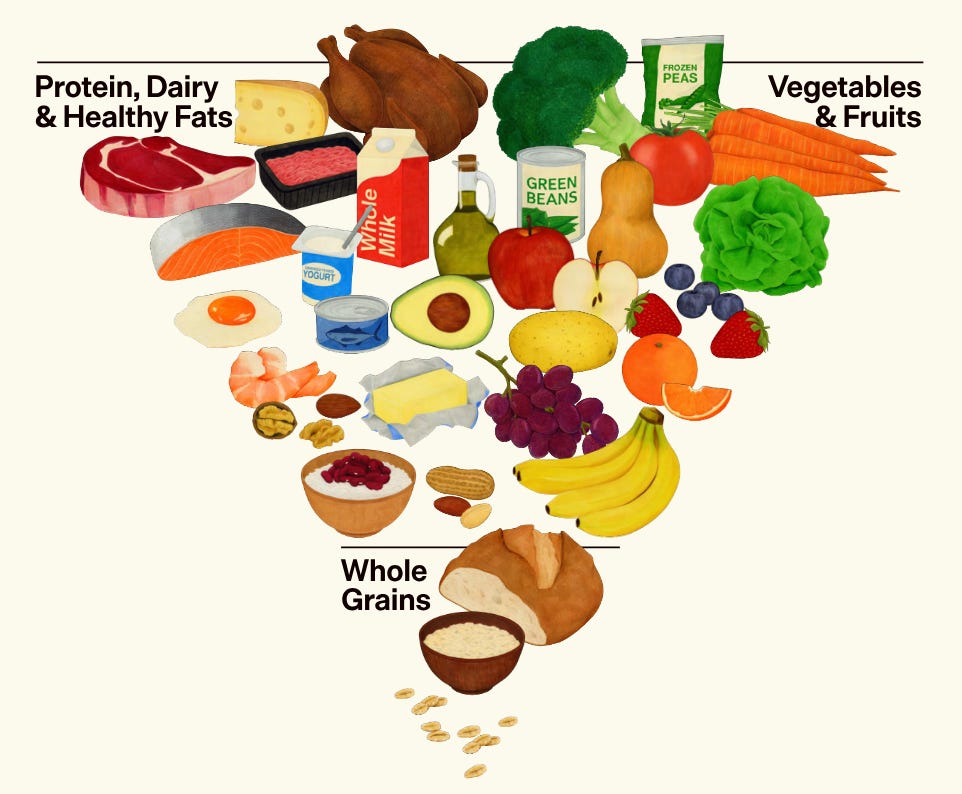
It’s best illustrated by the “upside-down food pyramid” that comes with it and has been shared widely:
I’ll spare the the South Park screenshot because, at this point, everybody has seen it. In short, the idea of turning the food pyramid upside down was literally the joke in a South Park episode.
In short, the new pyramid keeps copious vegetables & fruits. It adds back meat & similar animal products like eggs & dairy as 1st-grade, recommended ingredients.
Interestingly, it contains almost nothing high in omega-6 linoleic acid, the “bad” fat: the highest sources I can see are the nuts, the fatty parts of the whole roast chicken, and some percentage will be contained in olive & avocado oil, even if they’re unadulterated (which is unlikely to begin with). In addition, I don’t see ANY pork (high in PUFA, especially bacon) and the bread & grains we see are looking like oats, rice, & artisanally baked sourdough bread, not the off-the-shelf stuff made with soybean oil.
I am very pleased.
It keeps whole grains, but puts them at the (bottom) tip of the pyramid, whereas they made up the bulk (base) of the pyramid in the infamous “old, bad” food pyramid.
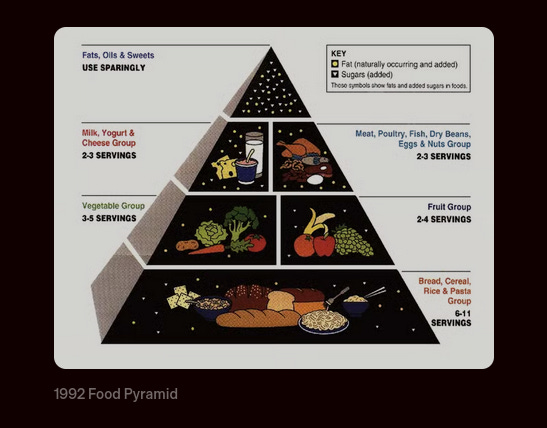
Notice that the entire bottom layer of the old pyramid is bread, grains, pasta, crackers, rice, etc.
Vegetables & fruit were prominent then, and they still are in RFK Jr.’s version. The tip of the old pyramid, “use sparingly,” is fats, oils, & sweets. RFK Jr.’s version leaves out sweets completely, and the graphic, at least, focuses on “natural” fats like butter, olive oil, and avocados, instead of lumping all fats together. I think this is a big improvement. We were eating beef tallow, olives, avocados, butter, and full-fat milk for millennia before the obesity epidemic. They are not the same as seed oils.
Notice also that this “old, bad” food pyramid is actually from 1992. It hasn’t been the official guideline for a long time, yet people like hating on it. I suspect this is 1. because it was the first such visual, 2. it came out when millennials and Gen Xers were kids or young adults, 3. the concepts haven’t actually changed much since, even if the graphic did.
The last iteration didn’t have a pyramid graphic, but instead showed the recommended MyPlate:
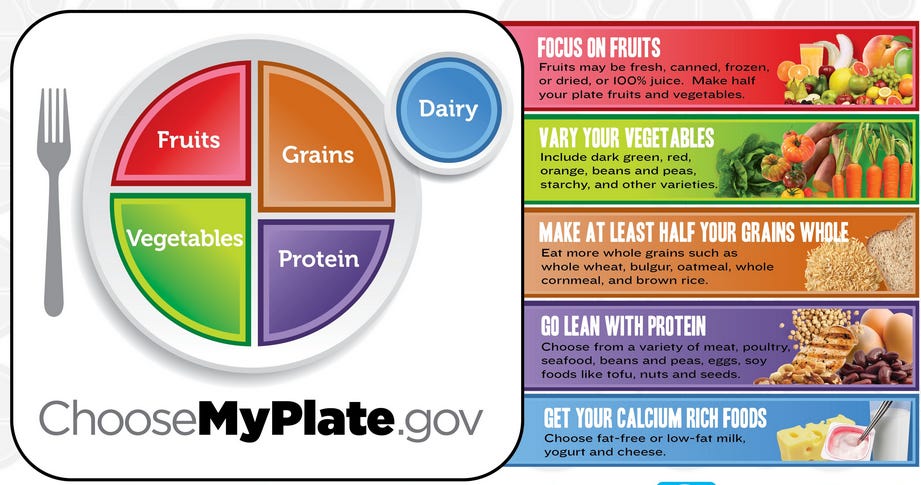
(Don’t bother going to myplate.gov, they apparently changed the content and are just linking to RFK Jr.’s new guidelines.)
Brioritize Brotein
The new guidelines put an emphasis “prioritizing protein.”
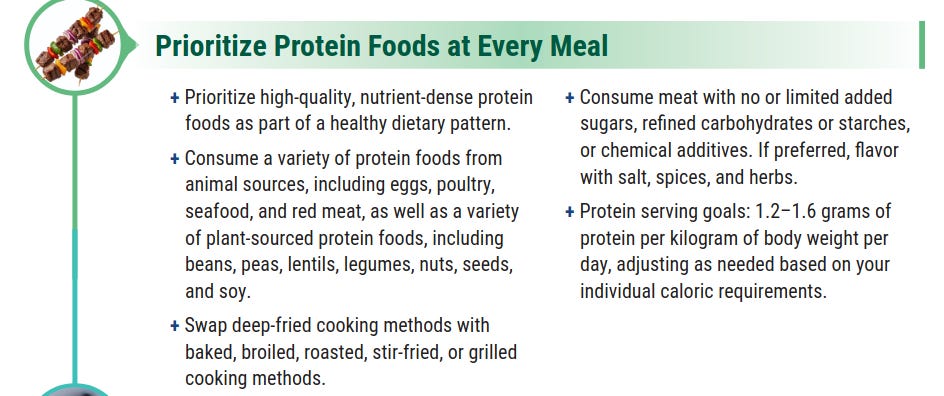
Now I am a vocal opponent of prioritizing protein except in special cases: elderly people or similar populations that have trouble eating.
I don’t think most Americans are deficient in protein. The Standard American Diet is 16% protein, which is more than enough for almost everyone. 10% would be enough for almost everyone.
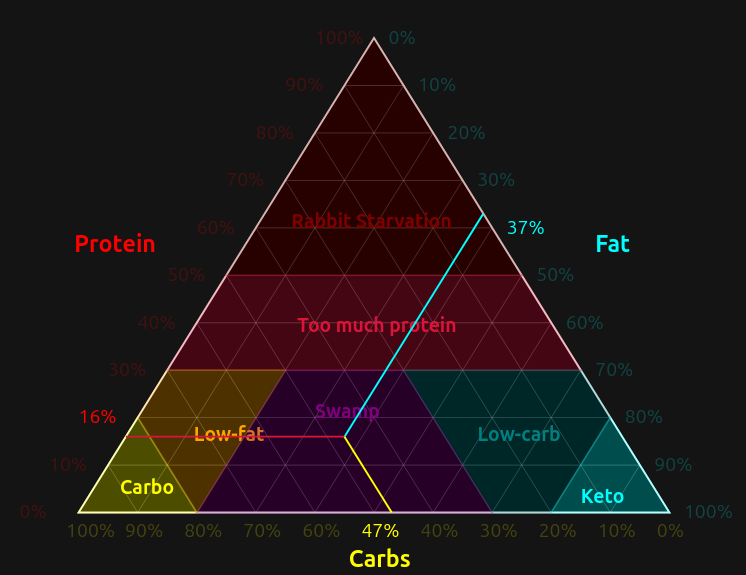
Still, I think that this will likely have a net-positive impact on a population level, at least until companies start putting “High protein!” on 100% of the junk food. (There’s already a huge push for this, you can buy “high protein!” everything now.)
Still, in combination with the “real food” message, I suspect it’ll push the average person away from the doritos and toward the ground beef, which would be beneficial. Or at least, I hope so. More on the unintended consequences of food guidelines later.
There is a group of people (I estimate maybe 30%?) who actually benefit & get healthier from eating LESS protein. I am among them.
But I think we can address that once we get people a bit away from eating 25% of their heat units from literal seed oils hidden junk foods. Protein does not lend itself to being adulterated with seed oils, not like carbs do. Even if you cook a steak in seed oils, it’ll only retain a little bit. You have to cover it in batter to give the seed oils something to soak into.
So unless everybody moves to more fried chicken, I think “moar protein” will be a net benefit. Again, on a population level - we should be ready to advise those this isn’t helping to actually try LESS protein for a bit.
On the specific amounts of protein recommended: the new guidelines suggest 1.2-1.6g of protein per kilogram of body weight, which is about 0.54-0.72g/lb.
I can’t find any per-weight recommendations in the old guidelines, but they give “ounce equivalents” of meat per total caloric intake. For adults, that seems to range from about 6oz at 2,000kcal to 8oz at 3,200kcal, their upper limit.
6oz is just over the 150g/day beef I eat on ex150, or about 7.5% protein. That’s an extreme level of protein restriction, if it’s your only source of protein. 8oz is 224g, half a pound, or 8.5% of total intake.
They also include dairy, grain & legume recommendations, which will contain some more protein.
Still, the old dietary recommendations advised what is, in the modern American context, a very-low-protein diet, close to the most extreme level of protein restriction I’ve observed in myself, others, and studies.
Now I don’t think most people need the 16% the average American eats, but also most people probably don’t need to restrict nearly as much as I do at 6%.
Make of it what you want, but RFK Jr. moved the recommendation from “very low protein” (that nobody was following) to “medium to high-protein”, which everyone is already doing. You can play around with a visualizer I made here, which shows the relation between protein intake & its percentage of total dietary intake:
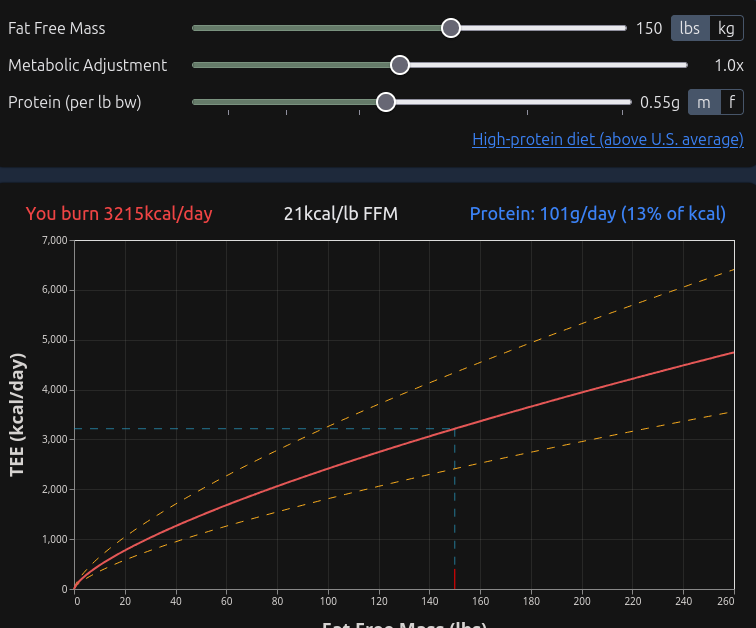
Here you can see that 0.55g protein/lb of body weight is just at the beginning of “high protein diet” for someone with what I’d consider a normal TEE of 3,215kcal/day.
Given that almost nobody but vegans and maybe seniors and me was eating as low protein as the old guidelines recommended, I don’t think it’ll change much.
People like meat and they’ll keep eating it. If they shift from fried chicken to ground beef I’m happy. If not, it doesn’t matter.
Dairy!
This one’s kind of funny to me. I love dairy, always have. By far my favorite food group. My current diet is almost entirely heavy cream.
But it’s still sort of funny how divisive dairy is as a category. It’s been extra demonized by some “experts,” maybe because it’s the big divider between vegetarian and vegan? Or because it’s one of the most saturated fat sources? Not sure.
Equally funny, RFK Jr. seems enamored with dairy, being apparently a proponent of raw milk. I remember that “experts” in my childhood thought dairy was extra important for growing kids, and maybe it is. It’s hard to tell what was the milk lobby back then, and which part of the anti-dairy back swing has been equally untrue.
In any case, the new guidelines have a separate point to advise you to eat dairy:
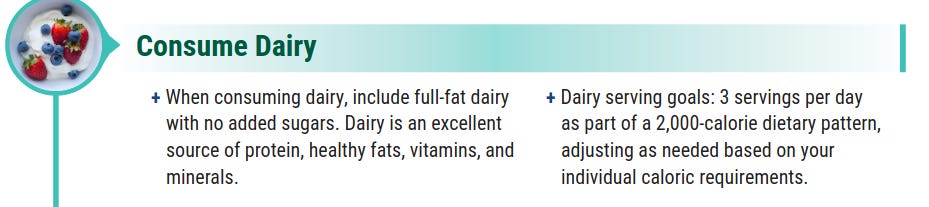
This is the THIRD point after “Eat the amount right for you” and “Prioritize Protein.” Podium finish for dairy. Impressive.
The old guidelines also included dairy, for the calcium, but recommended going low-fat or no-fat because they were scared of saturated fat.
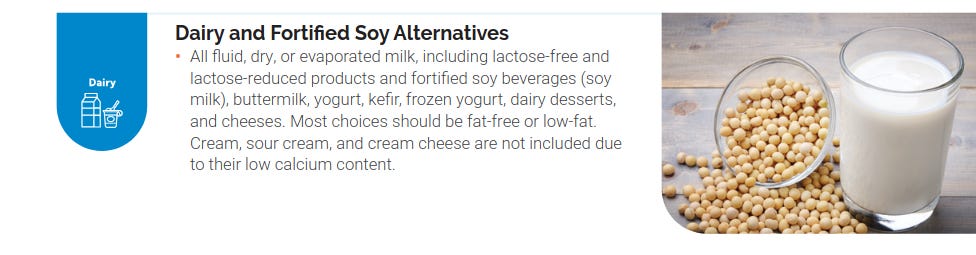
They also recommend soy milk and such to replace dairy, which I of course think is a terrible idea.
So while dairy had a special spot and still does, the actual recommendations have completely changed: RFK Jr. explicitly wants you to consume full-fat dairy.
I think reversing the low-fat nonsense is a great change, saturated fat harmed nobody.
On the other hand, “dairy” is such a broad category that I’m not sure it’s useful. I eat tons of heavy cream every day, but pretty much zero milk or cheese or yogurt, except during refeeds.
Whey protein powder is dairy, and I don’t think anybody needs to eat that.
Dairy is just too broad.
That said, I think on a population level this will be a positive shift, because it’ll nudge some people out of their fear of saturated fats. It might also shift people from higher protein (skim milk) to higher fat (full-fat dairy) which is a good, if small, shift. Everyone’s already getting enough protein anyway.
De-demonizing Saturated Fats
Another change I like is this:
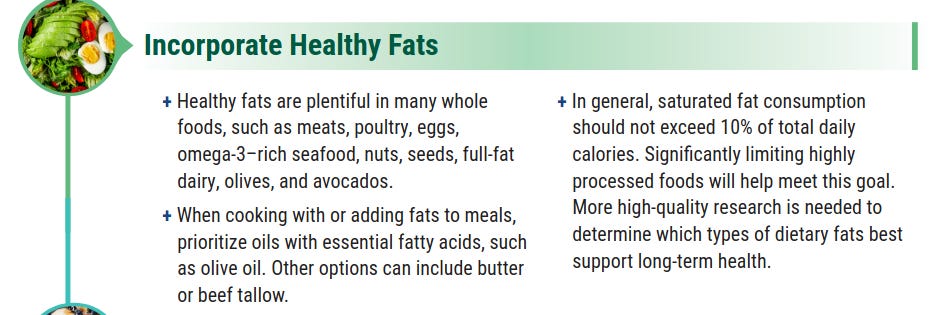
Beef tallow!
RFK Jr. completely reverses the saturated fat-phobic old guidelines, recommending what people have eaten forever. He doesn’t recommend ANY seed oils except eating actual seeds, and he recommends many fat sources high in saturated fats (e.g. beef tallow, butter, dairy).
He does mention essential fatty acids, which is sort of nonsense, but at least he advises you to eat olive oil instead of soybean or canola. Of course, even beef tallow and butter contain enough of the essential fatty acids, but at least he’s not recommending soybean oil for them..
Funny: in the right column of that screenshot, they still recommend only 10% of total carolies coming from saturated fat, and limiting highly processed food to achieve this.
10% is also the old number, I believe, and it’s completely incompatible with the left column, which recommends you add tallow, butter, full-fat dairy, and red meat.
In addition, most “highly processed food” is actually higher in PUFAs than SFAs, because seed oils are cheaper than beef tallow. With the “more research” bit on there, I suspect they didn’t want to commit to going full anti-seed oil yet.
I don’t think a single American ever targeted the 10% of saturated fat calories limit anyway. Some vegans probably reached it for ethical reasons, and everybody else ignored it.
The much bigger impact will come from the picture of steak & eggs, and the general rhetoric recommending full-fat “real foods” and ceasing to demonize saturated fats in general.
After the push to avoid UPFs, this is probably my second favorite change. I just think that “avoid UPFs” actually leads to much bigger reductions in PUFA than this point in most people.
Hole Grains
The last of the big bullet points is a focus on whole grains:
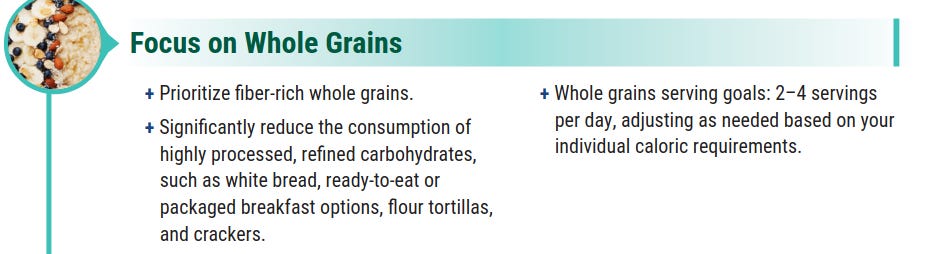
This recommendation isn’t that different to the MyPlate’s recommendation of 50% whole grains. Even the 1992 pyramid showed several whole-grain loaves of bread along its pasta and crackers.
I suppose it’s a slight shift in the less-refined direction, but the bigger shift is probably reducing grains from the base of the pyramid to the tip. The 1992 pyramid recommends 6-11 servings of grains a day, now down to 2-4.
It’s likely that the overall impact of this would be slightly positive. Most of the grains most Americans eat are packaged bread, crackers, tortillas, rolls, and so on. These are almost always made with seed oils, they’re fortified, grown with glyphosate, and so on.
I just wrote an entire post about what I recently learned about modern “bread” and what’s wrong with it.
That said, grains per se is a very wide category and modern bread is really the ultra-processed variant of it. If people switched from 6-11 servings of soybean oil-crackers to 6-11 servings of white rice or steel rolled, organic oats, that would probably have nearly the same health impact as just not eating any grains.
So it’s another one of those “Yes, but what will people ACTUALLY do?” ones.
Comparison with the last guidelines
The last guidelines wasn’t actually the 1992 food pyramid, even though everyone remembers that one.
Before we actually look at it, let’s point out that RFK Jr. explicitly focuses on the track record.
If you go to realfood.gov, you’ll be treated to a slideshow of Americans’ health status:
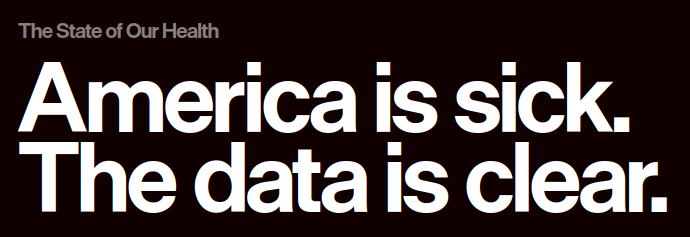
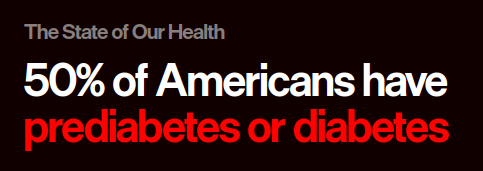
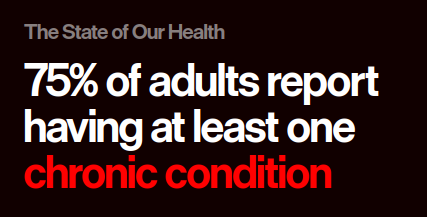
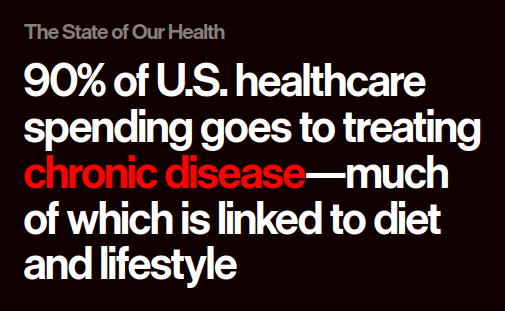
I think this focus on the data is great. Let’s be clear; American health policy has been an ABJECT FAILURE for my entire life.
You can argue that the 1992 pyramid or the MyPlate didn’t mean to do this, but they also clearly haven’t reversed these unhealthy trends. They haven’t even arrested or slowed them down!
It’s useful to argue “what did they intend to achieve” vs “what did they actually achieve.” We can’t judge programs and methods on their intentions, we have to look at the outcomes.
Of course this swings both ways: if the trends don’t get better after 5, 10, 15, 30 years of RFK Jr.’s “Eat Real Food” then we’ll also have to admit that he failed.
Saturated Fat Hysteria
In comparing the new and the old guidelines, we’ve seen that they aren’t necessarily that different overall. Both mention whole grains, both mention dairy. Both really like vegetables & fruits.
Yes, protein recommendations are up from “very low” to “normal/high.”
But to me, the biggest difference is that the old guidelines were, quite obviously, guided by a hysterical phobia of saturated fat.
The crazy thing is, they are from 2020. The irrational saturated fat-phobia, started by Ancel Keyes in the 1960s, has always been a total sham. But I could understand if you propagated it in the 1960s or maybe even 1980s. Maybe you just didn’t know.
But in 2020? We’ve known for decades now that the fear of saturated fat was always made up and never underpinned by any science.
By 2020, people had organized in big keto forums and groups for decades. I was keto 5 years before that point, which followed about a decade of learning about saturated fat & its history online. Paleo got big in the 2005-2010 era. Nina Teicholz wrote a whole book about the unjust demonization of saturated fat in 2014:
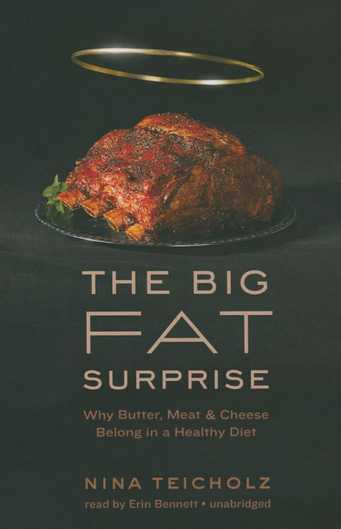
Now most people who believe SFA isn’t unhealthy, and who follow Nina Teicholz, are low-carb, paleo, carnivore, or keto people.
But that isn’t at all required. The big trend on r/SaturatedFat has been, for over a year now, a starch-based high-carb, low-fat diet.
It turns out saturated fats are great, but your body can also just make them. If you eat starches, your body WILL just make saturated and monounsaturated fat.
But the main effect of demonizing saturated fats was to push people towards polyunsaturated fats. This might not have been the intended effect, but it was the result. More on this later.
Almost the entirety of the old dietary guidelines is a result of the saturated fat-hysteria:
Eat lean meats, avoid fatty red meats
Low-fat/skim dairy, use soy “milk” instead
The only foods they recommend in quantities are grains, fruits, and vegetables, all of which are (nearly) free of saturated fats
If you cook, use seed oils:
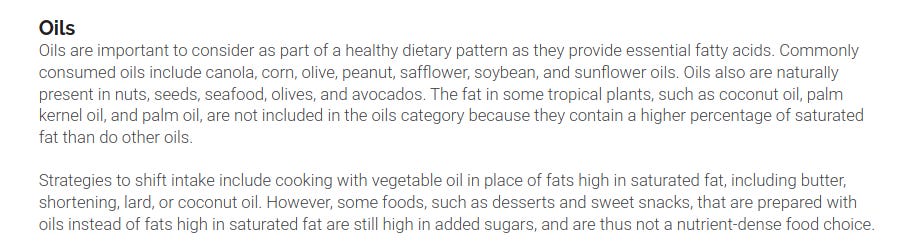
Fats are THE difference in the new guidelines
This is the main reason I’m extremely bullish on RFK Jr.’s new guidelines. The main difference is that saturated fat is no longer demonized. Even the “more protein!” recommendation largely follows this pattern, since the old ones were scared of protein mainly because people associate it with dairy and meat.
We can quibble a bit about the optimal amounts of protein per se, or how grains actually didn’t do anything by themselves.
But in terms of what most people will take away from the new guidelines, if anything: saturated fat is ok again.
And even in the mainstream, this change is quite late: most mainstream institutions stopped demonizing saturated fat years or even decades ago. The science never really supported it, but that has become clearer and clearer over time.
Still hysterically demonizing saturated fat in 2020 was, frankly, insane. Everything else was just downstream.
“Nobody followed the pyramid exactly!”
One point I see repeatedly from people on various sides is that nobody ACTUALLY did the exact food pyramid, and nobody ACTUALLY ate the exact MyPlate.
But that’s besides the point. Demonizing saturated fat was like yelling “FIRE!” in a crowded theater.
It doesn’t matter that you didn’t “mean to” cause a stampede that gets people trampled to death, because that is the predictable effect.
Even if you yelled “FIRE! Please exit calmly and carefully!” you can’t be surprised if people start panicking and rushing for the exits.
The 2020 dietary guidelines EXPLICITLY tell you to avoid saturated fats like butter, and to choose oils high in polyunsaturated fats. They also suggest as high as 34g of oils per day. If you were to choose the seed oils high in PUFAs as recommended, you’d get an insane amount of unhealthy linoleic acid even if you ate zero processed foods or nuts:

But that pretty much doesn’t matter. People don’t read the detailed guidelines and measure out exactly 34g of soybean oil.
The main “vibe” of the old guidelines, since Ancel Keyes in the 1960s all the way up until RFK Jr. released the new guidelines in 2026, was that SATURATED FAT WILL MURDER YOU.
In a society like America of the 1960s (or frankly, any western country) the response was obvious. Americans weren’t going to switch to a high-starch, low-fat diet like Japan was eating, or go to the equivalent but with oats.
The American diet was high in refined grains, somewhat high in sugar, and high in fats from beef and dairy.
If you yelled “SATURATED FAT!” in this very swampy theater, people were never going to rush towards the plain rice diet. They were always going to rush towards the other way of keeping their high-fat, high-carb, mixed diet: they were going to use margarine, shortening, and use seed oils for cooking and baking.
And, worse, the big companies and institutions would do it for them.
Institutional Impact
Another very underappreciated aspect of “But nobody followed the old guidelines!” is institutions.
It would be great if Americans cooked all their meals at home, but it’s not what happens. People eat at restaurants. They eat prepared foods from the store. They eat in school cafeterias, hospital cafeterias, or at their workplace.
These cafeterias, and the big food companies, don’t do their own diet research. They follow - shocking - the official government guidelines!
Even if every home-cooked meal was 0% in accordance with the dietary guidelines, a huge percentage of meals consumed in America would be influenced by the guidelines. Everyone at a hospital, be it patient or employee, would eat by the dietary guidelines. Every kid in school. Every student in a college or university. Everyone in the military.
And even the regular restaurants & packaged foods would be impacted; big food companies just follow the rules & regulations on the margin. Why? Because it’s easier than going against the grain or doing your own research.
Sure, there are many products that don’t follow the (old or new) dietary guidelines. But if a company is making a new product, and it doesn’t particularly matter for them what decision to make on a specific point (say, which fats to add to some junk food), and the price point is similar, they’ll probably follow the guidelines.
If you do what everybody does, and what’s officially recommended, you won’t get in trouble.
There’s a saying in computering: Nobody ever got fired for buying IBM. I don’t know if that’s actually true, but it summarizes this corporate, bureaucratic mindset well.
Nobody ever got fired or sued for using seed oils.
If you take a stand by adding beef tallow or butter to your crackers, you might one day have to defend that decision: in an actual court, to your new CEO, to screaming activists, or just the court of public opinion.
Just like McDonald’s switched from using beef tallow for their fries to using seed oils in the 1990s due to a public pressure campaign, Big Food Companies everywhere have very little interest in being in the news, being bullied by outraged activists.
Hence, when the guidelines recommend they avoid saturated fat and use seed oils instead, they follow those guidelines.
I don’t know what percentage of meals eaten in America are influenced by some form of institutional food production. There’s a spectrum. E.g. it’s literally illegal for schools, the military, senior homes, and hospitals to break the guidelines (if you disagree, frankly, fuck off. I know how incentive-based federal spending policy works).
So there is a percentage (10-20%?) of people who are legally REQUIRED to eat what the guidelines tell them.
Other groups are more loosely influenced, often just on the margins. Maybe the effective rate is about 30-50%, I don’t know.
But it’s obviously a huge amount, and even if no American ever cooked according to the dietary guidelines at all, they have a MASSIVE effect on American food consumption.
Conclusion
The U.S. dietary guidelines literally told people to replace beef fat & butter with seed oils, and the American people followed this advice, be it voluntarily or through institutions:
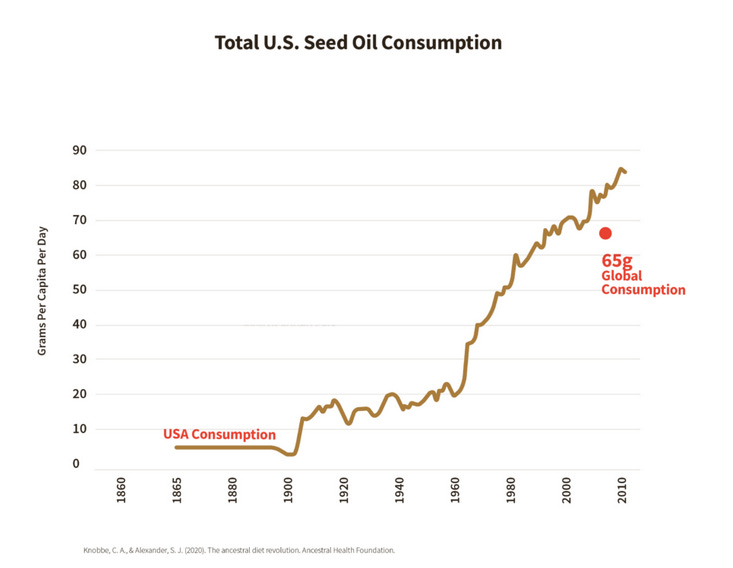
Crazy increase in seed oils after Ancel Keyes came out with the fraudulent saturated fat-hysteria in the 1960s. Probably a coincidence.
Let’s hope that these new guidelines will reverse the effect, at least partly. Heck, I’d settle for slowing the trend down!
At 75% overweight, 45% obesity, and 50% pre/diabetic, we don’t have much room. What are we going to do, just be 100% obese & diabetic? Who’s going to pick up the trash?
Even if you don’t like RFK Jr., and even if you don’t think everybody should be a steak-eating, high-protein carnivore bro, the health trend in this country has been insanely bad.
And I don’t care if you think the previous guidelines were intentionally wrong or just incompetent & nobody followed them; their effect was predictable either way. And even if you don’t think they could’ve predicted what happened back then, we can see it now. Hindsight is 20/20.
Let’s turn this ship around before we get to 100% diabesity.
On Twitter, Siohban Huggins posted this:
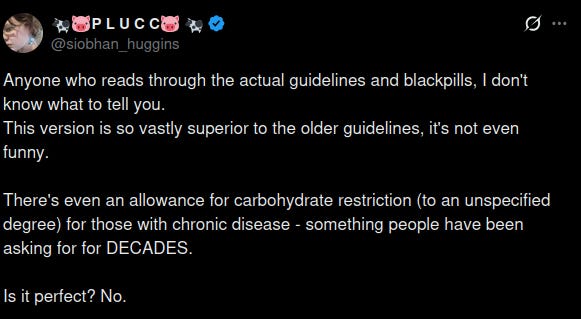
And my honest response was:

It’s not keto, but not everyone needs keto. Maybe some people inherently can’t tolerate gluten, or something else in bread, fine. Some people might not do great on lots of dairy. Ok, sure.
But it’s a huge broadside against the idiotic saturated fat-hysteria we’ve had to endure since the 1960s, and will hopefully lead people back to healthy fats.
Even if we get into PUFA technicalities, I have a hard time quibbling with it:
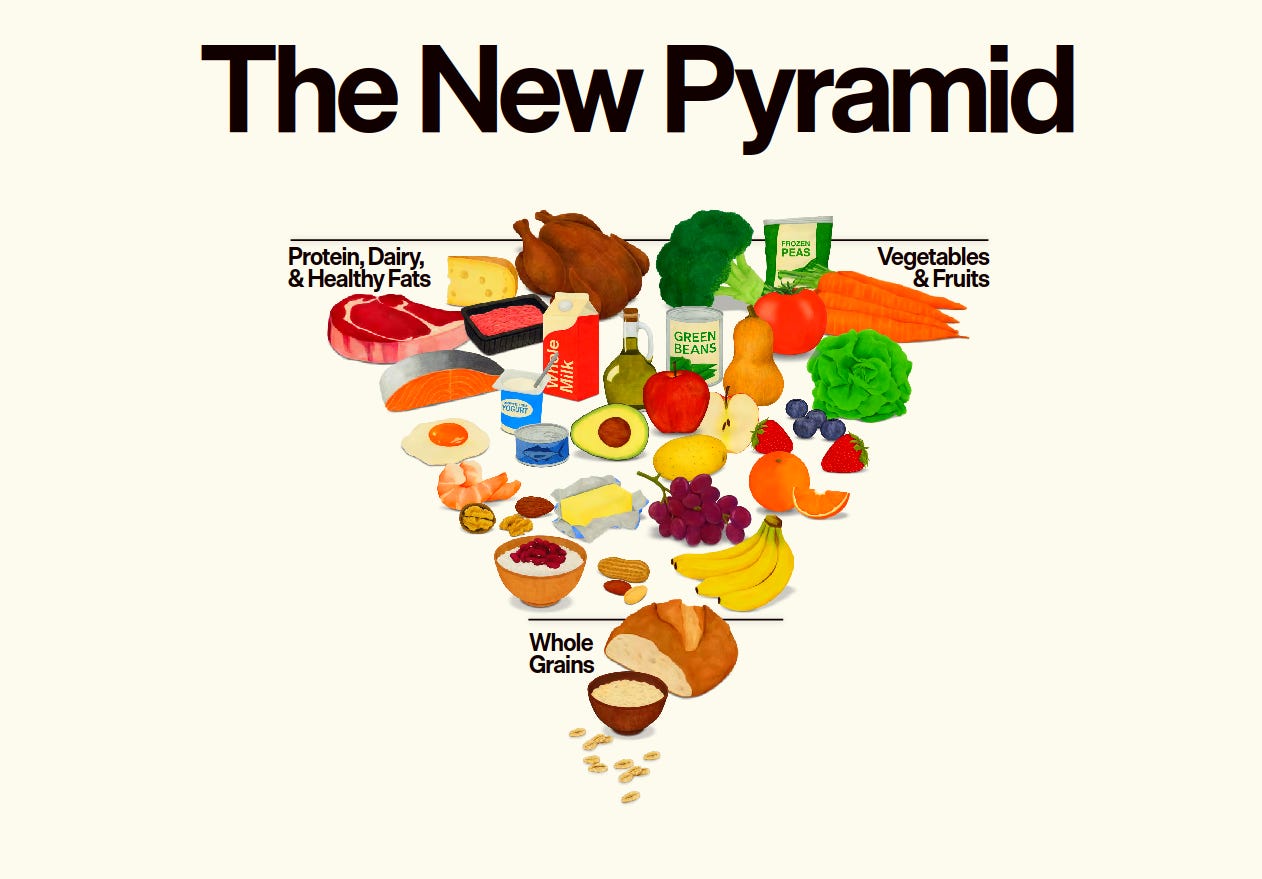
Sure, modern chickens are very high in linoleic acid. Olive oil can be up to 20% LA and is often adulterated. Nuts can be very high in LA and should be eaten seasonally or in moderation.
But THAT’S IT. It doesn’t even have bacon, or any pork as far as I can tell.
This food pyramid is better than anything I would’ve DREAMED of seeing in my lifetime.
Good job, Bobby. Making America Healthy Again is not political, everyone should be for it. Your dad would be proud of you.
I wonder how much of the rest of the world follows suit and starts recommending a similar food pyramid.
>My friends & family hate me because I constantly play this game with them and I never lose. NEVER!
For me people just give me labels to read for them or laugh when I roast some new products they bought to eat, lol.
I heard Bitten Jonsson, RN (she is a sugar-addict expert) say, "I am an opposite -er: I do red meat, salt, sun, and butter." I kind of agree with her!
If I take sugar from my diet (carbs), I can't be afraid of saturated fat because what else will I survive on?