
ex150nosauce+ACV-5 review: Bouncing off the new Bottom?
Mostly flat all month


Previously
Last month I did this exact same experiment and lost 8lbs, reaching a new all-time low (ATL) of 208.7lbs.
What is the experiment, ex150nosauce+ACV?
150g of beef & 80g of vegetables cooked in butter for one meal of the day
No sauce added to the meal (I used to use a lot of tomato and alfredo sauce)
Entirety of remaining food intake is exclusively from heavy cream, often in coffee, ad-libitum
Each morning, I supplement with 1 serving (3 capsules, 750mg acetic acid) of Bragg apple cider vinegar (ACV) capsules.
Hence: ex(periment) 150 (grams of beef) nosauce + ACV. And it’s the 5th iteration of this, hence the -5 at the end.
The Question, answered?
What I was wondering at the end of last month’s experiment: did the nosauce + ACV merely help me get back down rapidly to a certain “settling point” and would stop working there? Or would I smash through this new ATL (208.7lbs) and lose another 8lbs, which would’ve brought me close to the magic 200lbs mark?
The answer, if this month is any indication, is the former: it merely helped me rapidly get down to a new plateau.
Now the plateau is at a new all-time low, which is great, don’t get me wrong. But it seems that whatever is causing it (and I suspect it’s linoleic acid stored in my adipose tissue) is preventing me from going lower, even on a diet that had me lose 8lbs last month.
One note: I had originally set out to split this month into 2 stages of 14 days each, with a 1 day starchy refeed in the middle. I did not do this because it took me the full 14 days just to get to pre-refeed weight. Doing another refeed right then, I thought, would surely ruin the experiment: if I refed and then lost no new weight, it could’ve just been due to the refeed.
The experiment is just one go instead.
Tale of the Tape
Let’s look at what happened, then:
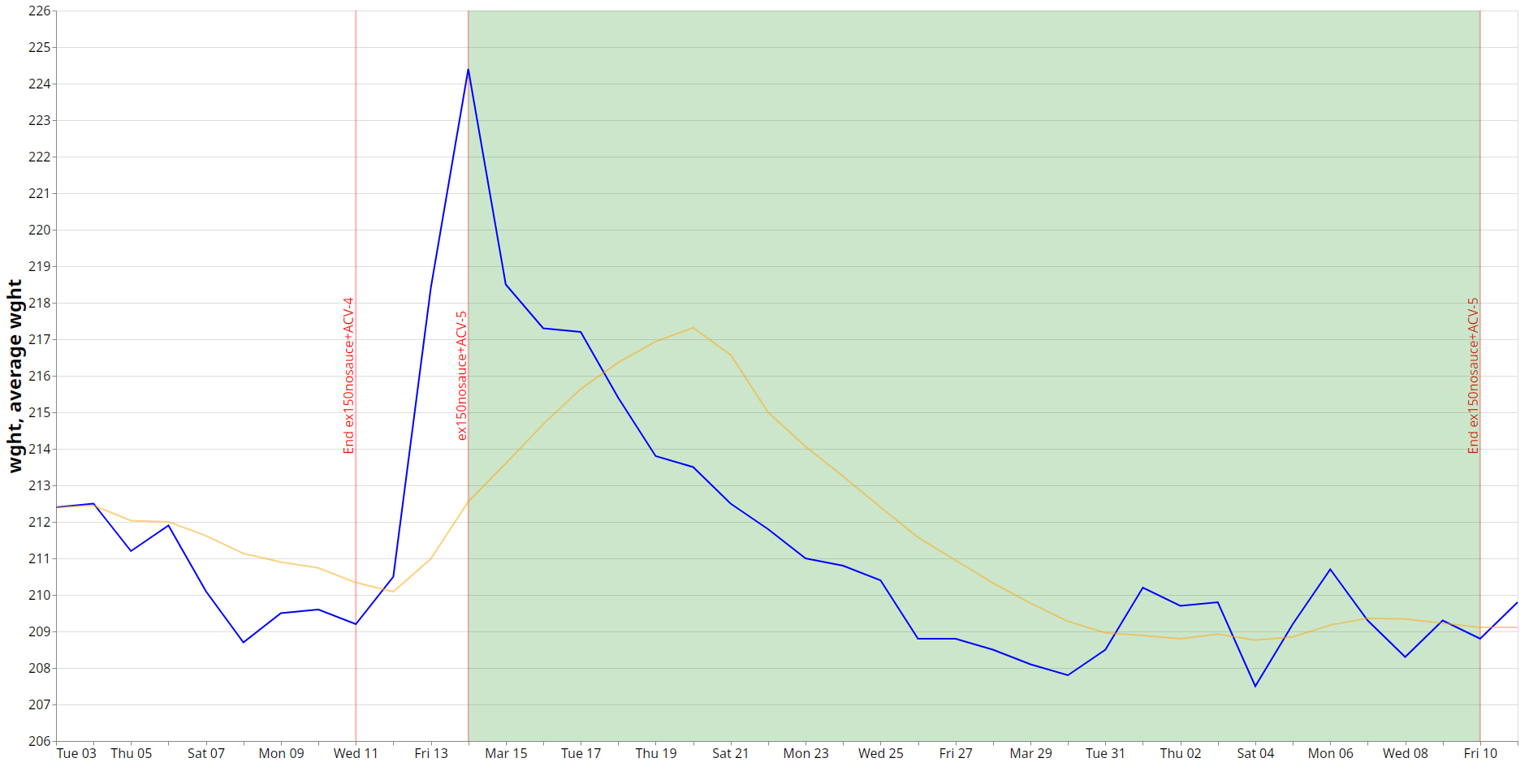
On the left you can see my previous ATL of 208.7lbs, 3 days before the end of ex150nosauce+ACV-4. My weight shot up 15lbs during the 2.5 day refeed, and slowly dropped for about 2 weeks.
This actually took longer than normal to lose the refeed weight, despite the refeed being only 2.5 days vs. last time, when I did one for 4.5 days. Maybe that was an early indicator?
I did very briefly hit another ATL of 207.8lbs. But the entire remaining 2 weeks of the experiment, I just bounced around in the 207-210 range.
Now I did cheat twice in those last 2 weeks, but I think that wouldn’t have been enough to mask or prevent 8lbs of fat loss from a previous low, as I had seen last month.
Neither cheat was very drastic: one was a ribeye steak (salted) instead of my regular dinner meal. The other was 2 slices of ham for Easter, when I was invited to somebody else’s house. Also salted.
I did also cheat last month, with a similar type of meal (brisket) and still lost 8lbs. Somehow I don’t think these 2 cheat meals were enough to deny 8lbs of weight loss for the entire month.
I suspect that this indicates that something else is preventing me from accessing & burning more of my body fat. My #1 suspect is, of course, linoleic acid stored in my body fat from decades of eating seed oils, commercial pork, chicken, nuts, and so on.
Set points vs. Settling points
I believe this is a settling point issue. Many people like to throw around the term “set point.” I have yet to hear anyone even make an argument for set points. The people arguing for set points in obesity, no offense, don’t know what the word means.
When you question them why they think there’s a set point, they don’t even try to make arguments: they just assume they’re right.
“I tried to lose weight and I didn’t” is not proof of a set point, and that’s usually about what you get.
Take this from someone with a background in computer science and who has had to learn what a PID controller is and implement one: it’s probably not a set point.
Now we don’t currently know for sure what miraculous mechanism keeps obese people obese. And yes, it COULD be a set point. But I don’t see any indication that it is, and I see lots of evidence against it.
But first, we’ll have to discuss what a set point even is.
Set points
The classic example is a thermostat. You set the thermostat to 70°F, and then your AC or heater keeps the house roughly at that temperature.
There is a goal state (the “set point”) and when the current state deviates from it, a controller like the aforementioned PID controller takes action by either heating or cooling until the world is at the goal state once again. (The PID part of the controller just indicates what algorithm the controller uses to do this.)
Now, is there a set point for obesity in our bodies? Is it set wrong? By whom or what?
We do sort of know several mechanisms that clearly play into this. The problem is, we’ve researched them all extensively, and none seem to actually be the root cause.
There’s insulin, leptin, ghrelin, FGF-21, GLP-1, and there are others. But while each of these seemed promising and clearly do something in the causal metabolic feedback loop that keeps people obese, they don’t seem to be a clear set point that is set incorrectly and lets us merely correct the thermostat to become unobese.
Settling points
A settling point, on the other hand, is not a complicated regulatory system like a thermostat. It is, in essence, simply a (temporary) equilibrium between various factors.
Imagine a mountain lake. There’s certain runoff from rain and glaciers and rivers that flows into the lake. There’s probably some overflow that continues downhill, and also evaporation. But there’s some sort of natural dam, which is why there’s a lake.
If it rains or snow melts, the water level in the lake might rise. If it’s dry for a while, the water level might drop.
But no matter how much water you were to dump into the lake, it wouldn’t rise beyond a certain point: the rate of outflow would drastically increase as you went, for example, over the natural dam height.
Similarly, many lakes never quite empty even when there’s no rainfall or snowmelt for a while, because the rate of outflow decreases naturally as the level drops beyond a certain point.
This isn’t necessarily anyone’s complicated plan, it’s a coincidence of nature and the entire reason why there’s a lake to begin with.
Many lakes therefore stay in a certain band of water level almost all the time.
Is there a “water set point” in these lakes? No. It’s just a natural equilibrium between inflow and outflow.
A man-made dam like the Hoover Dam might be built & configured to a certain water level set point, and the engineers running it can lower the water level by opening certain runoff valves. They could raise the water level by closing more valves and runoffs.
But not a natural lake.
Why even care?
At this point in the discussion, the set point people usually try to shift the goalpost set point and argue that it’s a distinction without a difference.
But there’s a huge difference.
If you were to find a mountain lake and you went looking for an office with an engineer inside who controls the set point, you could look for the rest of your life and never find it.
I’d argue this is roughly what obesity science has been doing. The have been searching for something that doesn’t exist. And lo and behold, they haven’t found it.
If you’re trying to understand something, being wrong about the fundamental nature of the system matters. A lot.
Slow Drop
Most people who’ve lost a huge amount of weight have a similarly shaped weight graph:
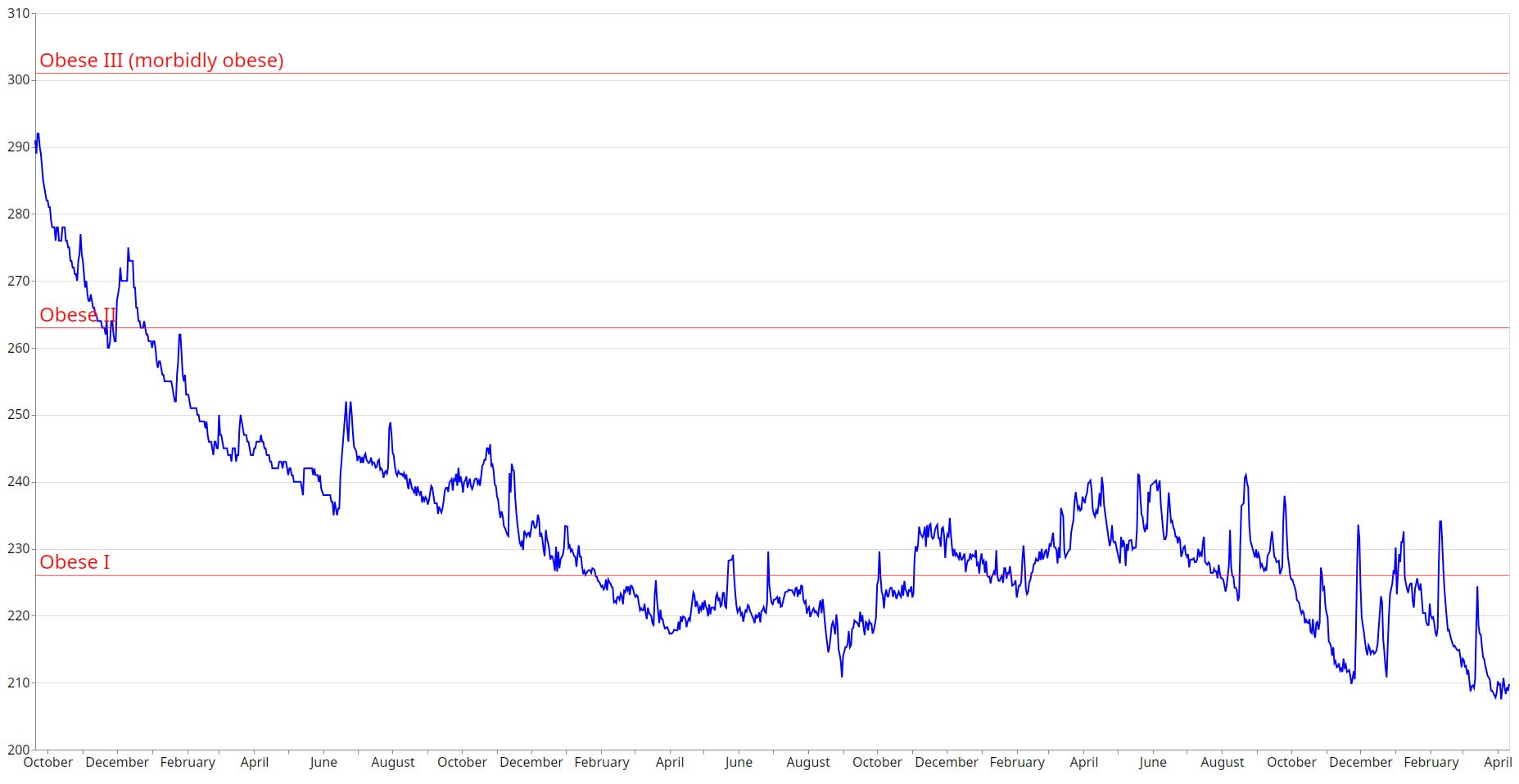
Rapid initial drop. I was down from 292lbs to 240 in about 6 months, and under 220 by about a year and a half. That’s actually when I hit that previous low of 217lbs. But then, the diet that had been working so miraculously for me stopped working, and I was stuck in the 220lbs range for months despite doing the same stuff as before.
Immediately, people online told me “duh of course you’re stuck, your diet isn’t working!” But it had been working super well for the first 50lbs?! Why did it stop? “Diets sometimes work and sometimes don’t” is neither satisfying nor helpful.
Hitting that 217lbs plateau was almost exactly 2 years ago, in April of 2024. Avoiding seed oils strictly and experimenting with a bunch of stuff, I hit my new low of 207lbs in April 2026.
In other words, it took me 2 full years to lose another 10lbs. You could argue that losing 10lbs in 2 years is very slow weight loss, but that’s not the point.
The point is that my “set point” or “settling point” or whatever was previously stuck around 217lbs, and now, 2 years of avoiding seed oils later, it’s at 207lbs.
This lines up suspiciously well with the theory that miscalibrated ad-lib food intake, satiety & obesity are mostly a function of linoleic acid (depletion) in our adipose tissue.
It’s commonly assumed among adherents of Modern PUFA Theory (MPT) that it takes about 4-8 years to deplete the linoleic acid from a lifetime of eating the Standard American Diet back down to healthy, ancestral levels of about 2%. The half-life of linoleic acid in body fat seems to be about 2 years, meaning our levels would halve every 2 years.
I started aggressively avoiding linoleic acid a few months after I began losing weight on ex150, so I’m about 3 years in, maybe a bit more.
Having lost a lot of body fat, but not quite being at “normal” levels (I’m still at BMI 27-28) is pretty much what this theory would predict at 3 years. Here’s a made up example of what my linoleic acid % might have been over the years:
Jan 2023: 25% - super PUFA’d after years of Standard American Keto
Jan 2024: 18%
Jan 2025: 12.5% - first halving done
Jan 2026: 8.5%
Of course I have no actual data for my body fat LA% because I don’t have access to regular (or any, really) adipose biopsies. And we don’t have a chart telling you what LA% causes you to retain how much body fat either.
But the “end goal” is typically assumed to be around 2% LA in adipose, and you’d already see most of the effects at 3% or maybe 4%.
My conclusion, so far, is then that Modern PUFA Theory is correct, and I will carry excess body fat when eating ad libitum until my LA is sufficiently depleted. This would likely take another 1-5 years, depending on what level I started at and how low I can go. (Actually hitting 2% would be extremely difficult even on my diet.)
Messing around with other diets is merely entertainment and helps me pass the time, MPT would predict, but ultimately I just have to wait until the linoleic acid is out of my system.
Notes
As usual I took notes. Honestly nothing super exciting this time. The diet is just so normal to me now that I don’t miss the sauce.
ex150nosauce+ACV-5
Only 14 days
Strike that, wasn’t down to previous low even on day 12.
Just doing regular 30 days.Day 1
Lol such a return to normalcy I don’t even notice I’m doing it
Day 5
Drank quite a bit of extra cream
Day 6
Super hot out
Day 7
Super hot out
Ate 2 tallow fries
Switched to salted butter (note: didn’t like the salted butter and switched back to unsalted after 2 days)Day 8
Hm water weight (?) still not quite off, taking a bit longer this time despite shorter refeed. Hm!
Dinner meal was super satiating today somehowDay 15
New ATL - 208.5lbs. Was 208.8 last 2 days haha.
So now we’ll see if weight loss actually continues, or if I’ll just bounce off the bottom
Last few days kinda felt a tiny, vague extra hunger.. PLH sneaking up on me again? (note: I don’t think it was protein hunger, just that fat loss pretty much stopped from here on out and I had to compensate by eating more)Day 18
Cheated w/ steak (very salty) & homemade bread
Day 21
Ran up about 1.5-2g of caffeine today, which made be dizzy: 5 celsius energy drinks & 5 coffees
Interestingly weighed in lower than my waking weight in the afternoon
Used very fatty beef patties (ripped up) for dinner that were incredibly satiating. Might be even fattier than 75/25, maybe 70/30 lol.Day 22
Patties incredibly satiating again
Day 23
Cheated w/ some ham and vegetables at Easter Lunch (refused seed oil sauce obv)
Light headache all afternoon lol. That’s what I get for cheating with pork.Day 25
Had a cup of cream cocoa directly after dinner, now wish I didn’t lol. Feeling slightly nauseated.
Small injury, swelling. Wonder if it’ll increase water retention.Day 26
Decided to shorten experiment to 28 days to time it with a weekend. Cooking complicated things on work days sucks, I want to enjoy the refeed over the weekend and be back on ex150 by Monday.
Day 27
Only slept 4-5h tonight for some reason
Refeed
Ate a friend’s home made butter cookies (seed oil free).
Huh, was in the store and got.. vegetables, beans, tomato sauce, a twix and 2 hard boiled eggs. Both eggs & twix were exceedingly meh. Then ate some black beans w/ tomato sauce & ACV from the can lol. Delicious!
Weird feeling to not be interested in my usual refeed foods. I picked up some cheese, beef jerky.. and then just put it back down.
I ended up buying some more candy and some cheese the next day, but it once again feels like I am less and less interested in “cheat foods” with every refeed.
I still made myself sick by cramming too much food in on the second day. Should probably start trying to shift away from these refeeds somehow, so that I don’t become hyperphagic every time.
Rinse, Repeat
Does this month prove that “it’s just linoleic acid!” and nothing else matters? No.
That’s why I’ll obviously just run the same experiment for another month. ex150nosauce+ACV-6 here we come!
I predict that MPT is true and that I will just bounce around 207-210lbs the entire month after losing any refeed weight.
If that were true, the implications are interesting. It would mean that I could probably do just about any diet experiment for the next few years and expect to lose maybe 5lbs a year in “settling point” weight aka weight I can “effortlessly” fall back down to eating ad-lib ex150.
I’ve long been interested in doing a longer term experiment of a low-fat, starch-based diet, mostly based on white rice. Something similar to whole-food, plant-based with some beef added. If all I’m doing is waiting around for LA anyway, I might as well “take 6 months off” from ex150 and do that instead? Or I could do some fun, stupid experiments, as I’ve done a few times in the past.
But first, another science real quick for a month.
Would it be possible to simply lose most of your body fat through GLP drugs, and then 'refeed' with a low-linoleic diet afterwards? The GLPs presumably wouldn't change the percentage of linoleic acid in your body fat, but it would change the absolute amount in your body.
Nice post, as usual. My first thought on seeing "PID" was linux process ID. Was expecting to see some kill -9 PID or some such.