
1 decade of keto
The first 10 years are the hardest


Just over a decade ago, between Christmas and New Year’s of 2015, I randomly began the keto diet. I had tried low-carb before, and was doing a vaguely Paleo + Rice diet at the time. I was over 300lbs then, although I don’t quite know how much, because I was avoiding the scale.
I forgot what or who exactly inspired me to try keto, but I do remember my goal was weight loss.
I lost 100lbs almost effortlessly within a year, ending up at around 200lbs for the first time in my adult life. I wore size M t-shirts. I got a suit tailored. Friends told me I looked “too skinny.”
Keto also put my chronic, life-long circadian rhythm disorder (Non-24) into remission - within 3 days.
It also improved my quality of life dramatically besides (and before) the weight loss. I slept much better. I was never very hungry - hunger just functions differently on keto, especially high-fat keto. I felt cool, calm, and collected - not like a chicken with its head chopped off, the stereotypical “blood sugar roller coaster” or whatever it is that so many people describe.
I have been in ketosis for almost the entire time since, for 10 years or about 25% of my life. The only exceptions are a handful of high-carb experiments I’ve done in the last year, e.g. ex_rice or ex_bread+butter.
Weight roller coaster: +/- 100lbs
Speaking of roller coasters, I regained the 100lbs I had lost during the first 12 months or so over the following 2 years, while still maintaining strict keto.
Why? Of course I’m not entirely sure, but it certainly wasn’t for lack of ketoing. In fact, as the weight crept on, I tried ketoing harder and harder - or what I thought, at the time, was ketoing harder, namely going more towards a steak/meat/carnivore direction.
I had actually started out with heavy heavy cream supplementation just to get the fat in. I also started keto while living in Asia, where meat, especially beef, wasn’t as readily available and affordable.
The weight gain happened exclusively after I had moved back to the U.S., which I considered “carnivore heaven” - affordable, delicious beef everywhere. You could practically eat nothing but steak & eggs!
I also started lifting weights, which increased my appetite - and made me gain weight even more quickly.
My diet then was what I would now consider extremely high in protein, like most Standard American Keto (SAK) or carnivore diets are. I now consider protein restriction a major part of my fat loss success on ex150.
It was also high in linoleic acid, again, like the SAK tends to be: a big pack of thick cut bacon every week, typically eaten with half a dozen eggs fried in the bacon grease.
If I ate out, I’d order the salad - with chicken breast and often drowned in dressing, aka soybean oil. If available I’d eat the fattiest cuts of chicken, or buy the Costco whole roast chicken and mostly eat the fatty parts. I ate lots of Korean BBQ, especially pork belly. My go-to snack was nuts with cheese, and I ate nut butters with a spoon.
No amount of fasting, eating purer carnivore, or working out would even stop the rapid fat gain, let alone reverse it.
Within about 2 years, I was back up at 280lbs. My weight gain slowed down a bit, maybe partly because I tried some pretty crazy stuff including extreme fasting. These “hacks” tended to lead to drastic weight loss in the short term, but I’d quickly rebound within hours to days of going back to any sort of ad-lib eating.
As an example, I fasted every weekday and only ate on weekends - for an entire month. That’s right, NO food intake for 5 days out of every 7 days, 4 times in a row. I lost no weight at all over the entire period.
Another time, I ate only 2,000kcal/day, mostly of In-n-Out (protein-style, low-carb) burgers, for about 20 days, after which I could no longer sustain the caloric restriction and my thermogenesis and immune system had basically collapsed. I started this experiment at 295lbs. I was down to 279lbs after the 20 days, but another week after resuming ad-lib eating, I was at 299.
Soon, I cracked the 300lbs. I hovered around there for quite some time and I just gave up. I stopped weighing myself, leading to a gap in my weigh-in data for about a year. This is a shame, as I have accumulated over 2,800 data points since my records began in late 2016.
In my body’s defense, even when I had “given up” and ate just about the shittiest version of keto you can imagine, I didn’t seem to go over 300lbs much. This is in contrast to before I first started. I don’t know how heavy I was exactly, but it was surely much more than 300lbs - I had to buy special large & tall clothes back then, which, at 300lbs on keto, I didn’t.
When people hear about this, they often ask: if keto didn’t work, why didn’t you do something else?
The answer is easy:
What else was I gonna do? I had tried everything else (or so I thought) before starting keto, and none of it worked either.
It reliably kept my Non-24 in remission, which was a life-altering improvement. Since it’s difficult to relate to this for normal people: imagine that you’re in a wheelchair, but you can walk as long as you do keto. You’d keep on doing keto even if you regained the 100lbs, trust me.
My Keto Renaissance
After having given up and accepting that I’d spend the rest of my life morbidly obese at 300lbs, my rejuvenated keto journey began with… the potato diet.
That’s right, the humble spud. I had started reading A Chemical Hunger by Slime Mold Time Mold, which had convinced me that something was literally in the water in America, and probably across the (Western?) world.
In 2022, these enterprising Citizen Scientists/Authority Disrespecters/Conspiracy Bloggers started a Potato Diet Trial. I didn’t formally partake, but their general attitude of “Let’s Science the Shit (tm) out of this!” had inspired me. And, frankly, what did I have to lose?
I took the summer of 2022 off, knowing that going on a non-ketogenic diet would bring my Non-24 sleep disorder back, and began purchasing large sacks of potatoes at my trusty local grocery store.
My records indicate - and, yes, this is basically when I started taking more serious notes besides just daily weigh-ins - that I only lasted 16 days.
I just could not eat enough potatoes. It was a very weird sensation: the potatoes tasted great, I just couldn’t… eat them. I’d go to the fridge, take out a delicious, pre-cooked potato, take a bit.. and be nearly unable to swallow.
Now you might say: that’s great, potatoes are so satiating! But they weren’t. I was starving. Ravenously hungry. I just.. couldn’t eat potatoes. I ate maybe 600kcal a day, which rapidly led to starvation symptoms. Only the first 7 days of that I was able to maintain a pure potato diet, with no spices, no salt, no sauces, no additions. The second week I added spices & sauces. Soon, I was adding a brick of butter to my potatoes, and the starvation symptoms went away - but of course that made it a “butter with potato flavor” diet, not a potato diet.
It also gave me terrible rashes all over my body. In retrospect, people tell me, I should’ve peeled my potatoes. I had not, because I was under the impression that the skin is the most nutritious part of the potato. But apparently it also contains tons of oxalates and other anti-nutrients.
Rashes were strange because I had never had skin issues my entire life, even at 300lbs. I barely had acne as a teen, and I didn’t remember my last rash before the potato diet.
By the way, my Non-24 sleep condition returned like clockwork a few days into the potato diet, and it disappeared again a few days after I stopped:
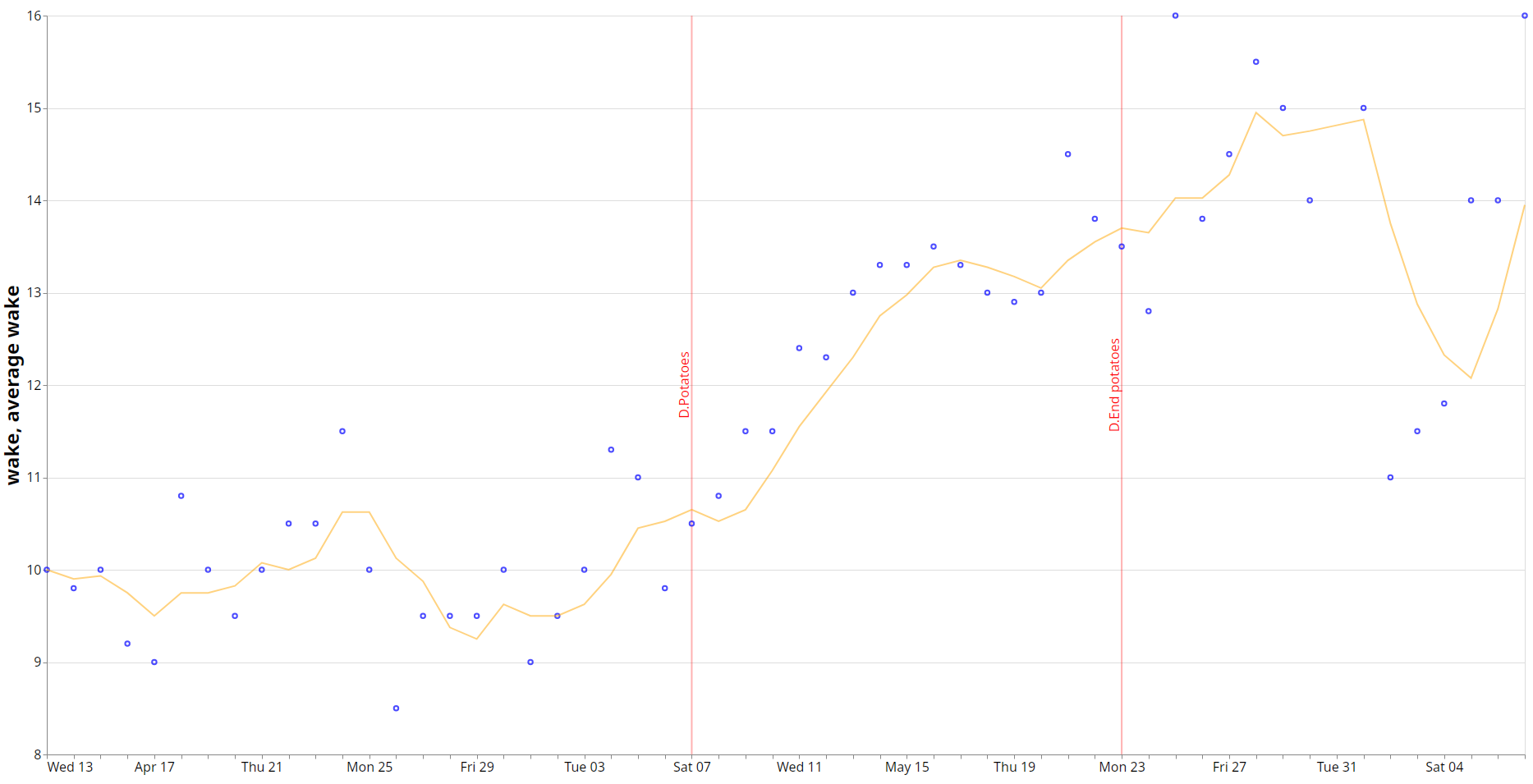
You can see I woke up around 10am most days doing my regular keto. A few outliers of 8:30am or 11:30am, but the trend was stable. On the potato diet, my wake-up time started creeping later and later nearly instantly, until I woke up in the afternoon, around 2pm. After I quit the potato diet, my sleep stabilized in the afternoon.
Oh yea, I have even more sleep data points than weigh-ins: about 3,200 wake-up times, in fact. I kept recording it even during the year when I’d given up on diet & weight loss.
Serious Experiments Lain
To give you a sense of this, here’s my 10 years of weight data (see the gap in the middle?) overlaid with my record of diet experiments:
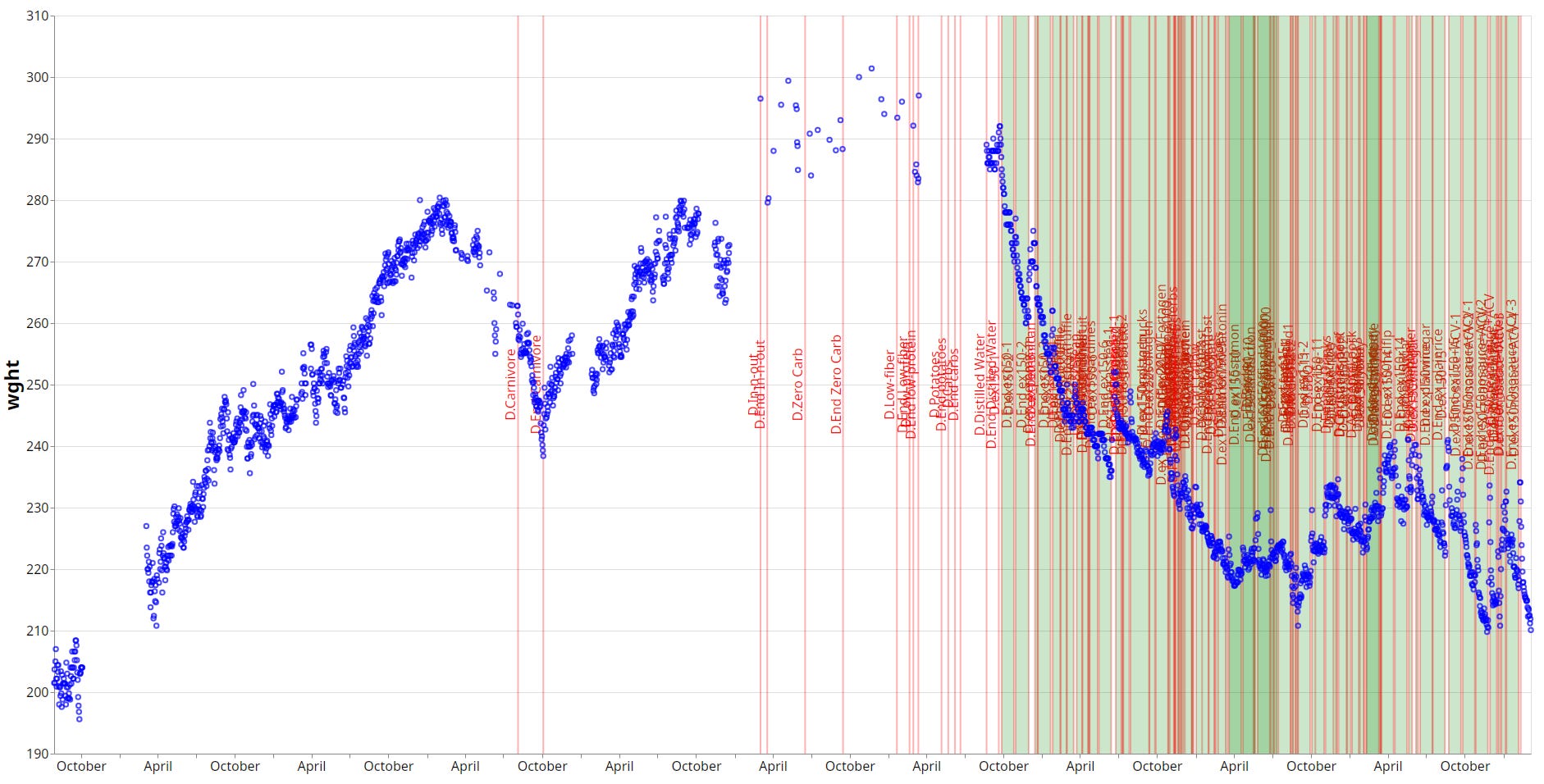
You can see that I only started getting serious about recording hypotheses and experiments in 2022, after getting inspired by Slime Mold Time Mold and their potato trial & experimental mindset. I did try random stuff before then, but wasn’t keeping detailed notes or records besides my weight.
Ever since late 2022, I basically did one experiment per month the entire time. Some I repeated, others were designed to be shorter or failed much more quickly - but I kept track of it all.
Third Time’s a Charm
Depending on how you count, I struck gold the 2nd or 3rd experiment after reading Slime Mold Time Mold and getting inspired.
After the potato experiment failed for me, I just went back to my regular old Standard American Keto ways for a few months. Then, I tried a month of only consuming distilled water. I even made my coffee only with distilled water. This was to see if reducing lithium in my drinking water would help me lose weight. It did not, I lost 0lbs that month.
For the following month’s experiment, I remembered a previous time when eating pretty low protein/meat and supplementing with lots of heavy cream had led to some success - and I started the heavily protein-restricted heavy cream diet that I basically do to this day: ex150.
The 150 in ex150 stands for 150g of beef, and that’s the daily amount of meat I eat. I eat it cooked in butter with some vegetables, and I used to add lots of sauce - although I stopped doing that about 6 months ago.
The entire rest of the diet is ad-lib heavy cream. This leads to about a 90% fat diet by kcals, depending on the (variable) cream intake, about classic ketogenic diet macros.
This was a total coincidence at the time, but besides being low-protein and highly ketogenic, this diet is also extremely low in the polyunsaturated omega-6 fatty acid linoleic acid (LA). Compared to my previous Standard American Keto, ex150 contains no chicken, no pork, no salad dressings, no bacon, no eggs, no nuts, and no olive oil.
ex150 is about the lowest-LA ketogenic diet you could do. The only way to go much lower in LA is to keep the same strict standard for ruminant (or similar like cocoa/coconut) fats, but reduce the total fat content of the diet.
Of course it wasn’t on purpose; I basically didn’t know about seed oils at the time. Only a few months later, when I began posting about my weight loss success on the internet, did people inform me, and I’ve since become a big proponent of Modern PUFA Theory (MPT). It seems to explain my 100lbs weight rebound while maintaining strict keto the entire time.
And boy, did I lose weight on ex150:
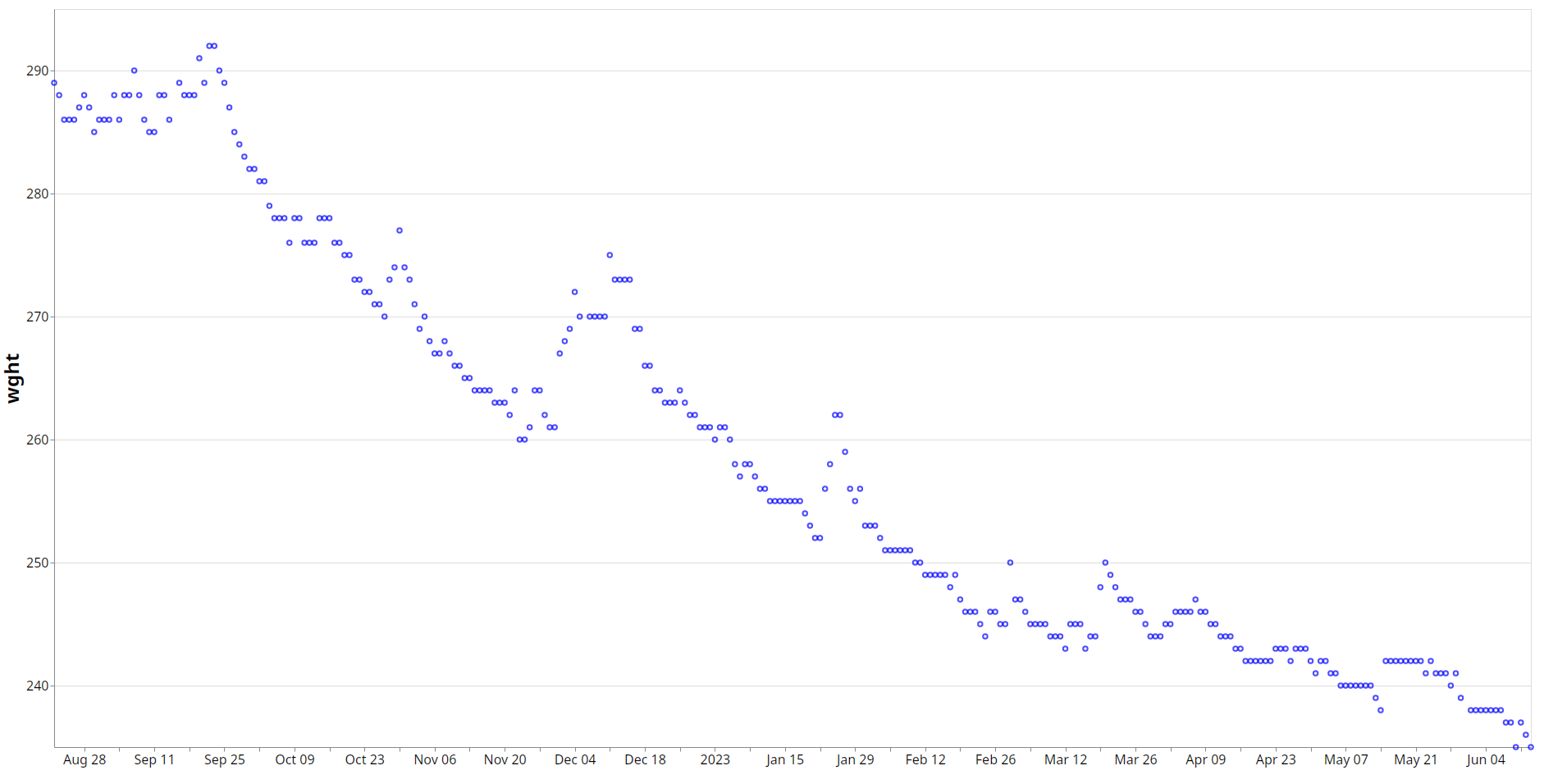
The horizontal lines are 10lb marks. I lost 30lbs the first 2 months, and another 10 the following. Then I took a pretty big break and regained some weight, and it took about 1.5 months for the next 10lbs, and 3 months for the next.
That was 55lbs down, effortlessly & eating ad-lib, in about 7 months, including some breaks. No hunger ever. No intentional caloric restriction.
The now-popular GLP-1 drugs weren’t available (or known as much) then, but compare this to a trial on Tirzepatide, the 2nd-generation GLP-1 drug:
I lost over 18% of my body weight in 7 months
The highest-dose, best-performing group on Tirzepatide lost, on average, 14.7% of their body weight in 18 months
In short, I lost more weight than the best performers on Tirzepatide, in less than 40% of the time, without the associated lean mass loss or any of the side effects. People sometimes ask me why I’m so down on GLP-1 drugs; this is why.
Then I began to plateau, and that’s when I began to experiment with more ideas instead of just “sticking to the plan” (the plan being ex150) cause it always worked.
When the plan stops working, you need to adjust.
ex150 did keep working in the sense that I never gained a single pound on it, no matter how much heavy cream I consumed. Some weeks I averaged over 4,000kcal/day, yet no fat gain.
I do somewhat believe that fat gain on an ex150-style diet is nearly impossible, at least if you don’t purposefully overfeed yourself. Maybe even then. I should try it some day.
About 2 years into ex150-ish diets, user Whatsup_Coconut on the r/saturatedfat subreddit challenged me: having cut out PUFAs, did I even still need keto to keep my Non-24 sleep condition in remission? I would’ve bet a lot of money that I did, but she was right: the Non-24 was gone. I no longer “needed” keto, and could now eat entirely rice-based or bread-based diets for months on end, and sleep just fine.
This opened up a lot of non-ketogenic diet experiments for me.
The 3 phases of my keto decade
While I’ve been in ketosis for most of the last decade, the experience was very heterogeneous. I’d separate it into these phases:
Year 1 - Honeymoon: Non-24 gone, lost 100+ pounds, great quality of life
Year 2-6 - Desperation: Fought rapid fat regain tooth & nail, but lost every battle. Ballooned back up to 300lbs
Year 7 - Resignation: Totally resigned to being morbidly obese for the rest of my life
Year 8-10 - Renaissance: Protein-restricted, low-PUFA heavy cream diet. Everything “keto” was for me in the beginning and more. Cured Non-24, seemingly permanently. Down over 80lbs again, eating ad-lib.
Conclusion: Should you Keto?
Overall, even though I’ve experimented with carb-heavy diets recently, I still feel by far the best on a high-fat, low-protein ketogenic diet.
There’s just an almost ethereal quality of life to it. I am never hungry. I am never tired. I am never exhausted. I just have infinite energy reserves, all day, every day.
Nutrition becomes effortless: fat is extremely energy dense, and clean (=low-PUFA) sources are available everywhere for very cheap (per carolie). You can walk into any McDonald’s on the planet and order plain beef patties for the protein. You can walk into nearly any Starbucks on the planet (yes, I’ve done this on 3 continents) and order a heavy whipping cream latte. You can walk into most grocery stores, purchase a pint of cream, drink it on the spot, and be fueled up for the rest of the day for maybe $5.
Whereas eating a high-carb diet seemed to require constant attention, effort, and fiddling, being in deep ketosis feels like being a shark in deep water: calm, cool, collected. Focused.
Not everyone seems to get this, but some people clearly do. Those people just LOVE keto. I am among them. My body clearly thrives on ketosis.
That said, not everybody seems to do well on it. That’s probably just genetic influence: we have quite a few genetic adaptations that vary strongly over the last 5,000 years. I am probably in the 99th percentile of dairy tolerance; I drank half a gallon of milk a day for most of my childhood. I can drink a pint of cream straight and get zero side effects or symptoms except cement-truck satiety.
Other people probably need more meat, or thrive on carbs instead. Some people just love starch diets. Others love fruit/sugar based diets.
Besides finding the type of diet your body was made for (e.g. high-fat keto, dairy based, meat based, starch based, fruit/sugar based) the most important part is cutting out linoleic acid strictly.
In this regard, keto is technically orthogonal, but in practice is a minefield.
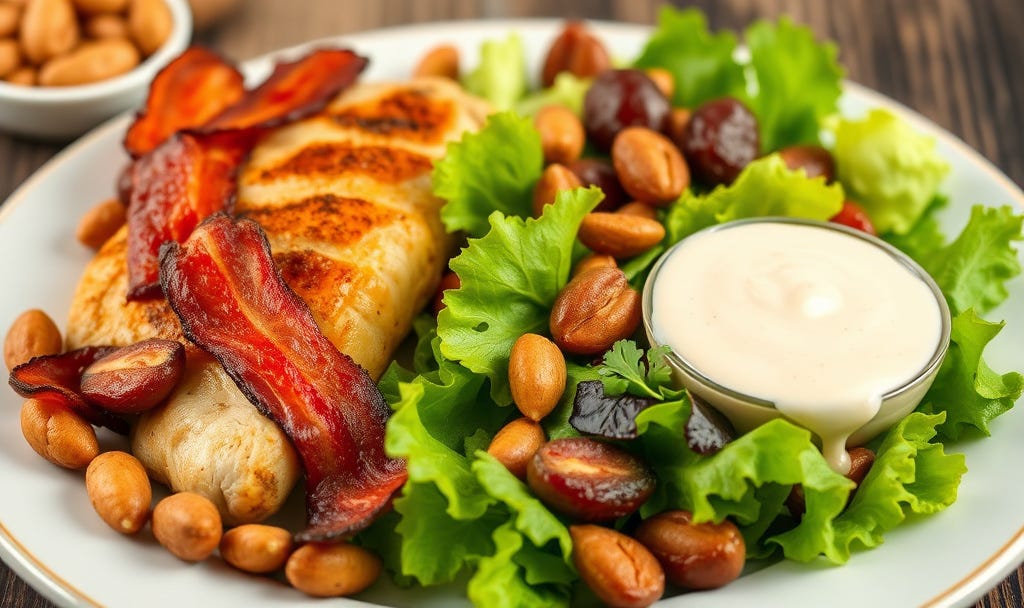
Standard American Keto (SAK) is extremely high in linoleic acid: bacon, pork belly, sauces, salad dressings, eggs, olive/avocado oil, roast chicken, nuts, and nut butters.
If your goal is <2% of daily carolies from LA, and you eat a 70-90% fat diet, your fat sources must be EXTREMELY low in LA. As you approach 100% of food intake from fat, your limit approaches 2%. That’s basically only ruminant fats plus cocoa butter or coconut oil. Grass-fed ruminants preferably.
On the contrary, it’s much easier to stay below 2% LA total if you eat a low-fat diet to begin with - unless you purposefully seek out literal seed oils or use soybean oil dressings.
Many “plant-based” diets are pretty good in this regard in theory, e.g. Starch Solution. On the other hand, many common plant fats are pretty bad - all seed oils are, of course, plant-based.
In short, I think it’s much more important that you drastically cut out linoleic acid than do keto. If you thrive on keto & want to use it as a vehicle for reducing your LA intake, that’s great. If you prefer another vehicle like High-Carb/Low-Fat (HCLF), that’s better than Standard American Keto.
Figuring out Your Optimal Diet
I propose not an optimal diet for everyone, but a framework: run 30 day experiments along a few simple guidelines, and you’ll probably find the diet that fits you & your genetics best.
Avoid linoleic acid strictly for the rest of your life. No seed oils. If you eat animal fats, only ruminants (beef fat, dairy, sheep & goats would be ok too). No nuts except macadamia. Pretty much no avocado/olive oil: besides being heavily adulterated with seed oils in practice, they tend to be relatively high in LA even if “clean.”
If you must eat out/eat commercially prepared foods, NO SAUCES and NO DRESSINGS. Avoid anything that oils could’ve been mixed into, like stew or curry. Get the steak & asparagus or baked potato. Avoid their “butter” and “sour cream.”Figure out the best major energy staple for you: fats, starches, or sugars. I do very well on (low-PUFA) fats, so-so on starches, and terribly on sugar. I know a few people who absolutely thrive on mostly sugar diets, but not many. On the other hand, quite a few people do best on starches. Maybe even more than do on keto.
To figure this out, simply run a handful of 30 day experiments: one mostly starch-based, one mostly fat-based, one mostly fruit/sugar-based. You’ll probably know within 2 weeks if your body tolerates this well, and by day 30 you should have a good weight trend. Allow 1-2 weeks for adaptation, both when you go ketogenic (high-fat) and when going from a high-fat diet to a high-carb diet. It took me about 2 weeks to adapt to all that starch.
If you trial starches, I recommend starting with white rice: it seems the most easily tolerated by many people. You can put some beans and a little bit of beef into the rice for nutrition & flavor.
If you trial fats, and your ancestry supports high dairy consumption, I absolutely advise you to do heavy cream. It’s surprisingly delicious, and if you have British/Scandinavian/Northern European/Steppe ancestry, you’re probably extremely good at it. If not, try fatty beef or other ruminants as available to you.
If you absolutely hate keto, maybe it’s not for you. I personally could barely tolerate the sugar diet, a week of it wrecked me. Same for potatoes (as mentioned before), but I do pretty great on rice. Play around a bit if you don’t hit a home run in the first few 30-day experiments, it might take a few attempts.
You can tell if a food is a good energy staple if it tastes good but isn’t “addictive,” gives you good satiety, digests well, and leaves you feeling good and energetic as opposed to causing bloat/digestive issues or leaving you lethargic.When you’ve dialed in your preferred energy staple, play around with your protein intake. I wouldn’t advise you to go much below 10%, although I’m personally doing 6% - but that’s skirting the line.
10% protein is about what’s in most staple starches like rice, potatoes, or wheat. You therefore don’t need to add much meat or dairy protein to get to a reasonable level.
In terms of actual requirements, most people don’t need more than 10% unless they’re extremely active athletes. Some people tolerate very high amounts of protein, others don’t.
Try to dial this in: if you don’t feel great yet, or you have quite a bit of weight to lose, you could try lowering or upping your meat intake. Many people thrive on high-starch with modest protein, basically what most of our ancestors ate since the agricultural revolution.
Others do great on a 30% protein carnivore diet. If that works for you, God bless.
Protein is a bit harder to dial in than the other things so far; the symptoms can be subtle. Personally, excess protein makes me run hot, feel terrible, gives me indigestion, and makes me insatiable despite having a stuffed stomach.
On the other hand, lack of protein also makes me insatiable, but in a different way: my stomach feels like a black hole instead of being painfully stuffed.
One simple heuristic: if you feel insatiable despite having eaten a bunch of your energy staple (e.g. starch, fat) that should give you satiety, eat one big, reasonable portion of meat. E.g. eat a steak, or a pound of ground beef.
If such a protein bolus quiets your insatiable hunger for a few days, it was probably due to lack of protein. If, instead, you’re hungry again 45-120 minutes later, you might benefit from lower protein intake.There are a few more minor tips, tricks & hacks you can do. I’ve written about vinegar & glutamate from tomato sauce plenty on this blog. But this is the “meat & potatoes” of my current framework, and it seems to fit pretty much all the anecdata and experiences I’ve seen out there.
If you’ve done steps 1-3, you’ll probably have a staple diet that feels great, is affordable, vastly improves your quality of life & will continue doing so, slowly, over the next 4-8 years as you deplete the linoleic acid stored in your body.
You might find your digestion improve, random health conditions simply disappear, your teeth & vision improve, your pain tolerance increase, your joint pain go away, your body fat melt off, your sense of food satisfaction & satiety normalize, your skin barely sunburn any longer.. and that’s just the first 6 months!
It basically boils down to: are you genetically adapted to be a hunter (=meat heavy diet), a pastoralist sheep/cow herder (=dairy), a farmer (=starch) or a gatherer (=fruit/tubers)?
There are some mixes, but these seem to be the basic dimensions of “proper human diet.”
Personally I appear to be mostly a pastoralist with low meat tolerance, low fruit tolerance, and I do ok on certain old-world starches (rice, bread) but nearly no new-world tubers (any sort of potato/sweet potato). This makes sense given my Northern European ancestry, where people would’ve eaten some meat, lots of butter/milk and bread.
I know people who thrive on high meat combined with lots of fruit & sugar. Yet others are practically plant-based, starch all the way.
Human nutrition is slightly complex, but it’s not impossible to solve. There are only so many dimensions.
Forever a Ketard?
Despite no longer needing keto for my Non-24 (thanks, Modern PUFA Theory!), I continue to feel the best, and lose fat the best, on a 90%+ fat low-PUFA, protein restricted keto diet.
It’s no contest.
Will I be a ketard forever? I don’t know. Probably for the foreseeable future, with the exception of the odd carb experiment here or there.
My hope is still that depleting enough linoleic acid from my body fat over the next 1-4 years will eventually allow me to eat pretty much anything and remain metabolically healthy. But I’m not there yet, and there’s no guarantee it will ever happen.
It seems I’ve figured out how to avoid the pitfalls of Standard American Keto, and I feel better on ex150 than I ever have on any other diet.
But if it’s no longer required, I could see myself opening up the diet and include other foods, especially starches like rice and bread.
Until then, cream it is.
You are an inspiration. Thank you.
I seem to tolerate protein pretty well, but the main thing I notice if I eat too much protein is that I'm very thirsty for an hour or two after a meal. If I really over do it, I'll get get hot and sweaty overnight ... but that hasn't happened for ages. Not even sure if I could eat enough protein to get "the meat sweats" anymore! Maybe I should try.
When I was first doing keto, I'd feel kinda weird and gross if I ate a lot of protein (over 200g), but that doesn't seem to happen on strict carnivore. So maybe I adapted to higher protein, or maybe there's something about not having carbs/fibre with protein?
Note I wasn't trying to lose weight, I was trying to get rid of autoimmune symptoms.