
How to Find your Personal Optimal Diet
A map to navigating the diet landscape


A friend asked me to expand on my “algorithm” to find your personal, optimal diet that I briefly touched on in my recent post about my decade of keto.
I did a similar post a little over a year ago, summarizing my thoughts about obesity & fat loss as of early 2025.
What is ExFatloss about?
I have 2 goals with this project. The first was to reverse my own (morbid) obesity. I did that about a year into my ex150 heavy cream diet.
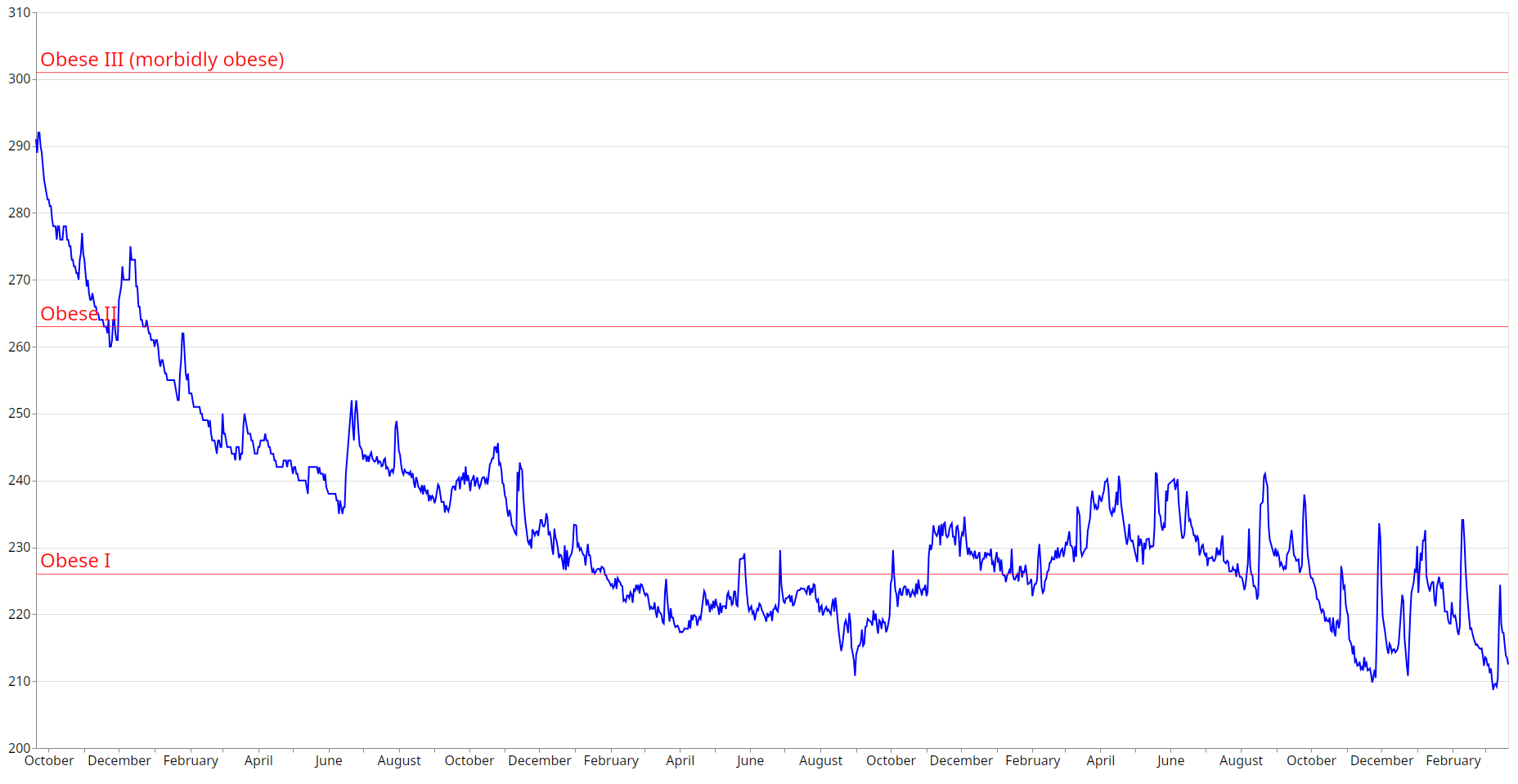
In this graph, the red “Obese I” line represents the border between “overweight” and “obesity” as measured by BMI. It’s at about 227lbs for me. You can see that I broke through it in January of 2024, about a year and 2 months after I started ex150. And I tend to stay below that line unless I experiment with other diets.
The second goal is to find out what caused the obesity epidemic to begin with, and, hopefully, solve it.
I am fully aware that not everyone wants to spend the rest of their lives living off of heavy cream. Heck, if I find a way to pull it off, I’d probably eat a more varied diet as well.

My current hypothesis is that I’ll be able to eat a more “normal” and varied diet once I deplete enough omega-6 polyunsaturated fat (linoleic acid) from my adipose tissue, which I had stored over a lifetime of excess linoleic acid consumption.
Of course for some people, my diet might not even work if they tried it. Human dietary genetics have evolved significantly in the last 5,000 years alone, and we have vastly different abilities to live/thrive on certain foods. Our ability to deal with lactose, casein, starches, and fats has a huge genetic component. Maybe other things, too.
So even if I got to shredded six-pack abs drinking a quart of heavy cream a day, how does that help you? You probably don’t have my extreme pastoralist dairy genetics.
Create your personal Map to the Diet Landscape
Well, it’s more of an algorithm than a map. We’re all trying to figure out the map together, each of us experimenting and trying out different areas.
I can tell you what works for me. I can tell you what has worked for quite a few people, and what works for almost nobody. You could say we’ve colored in parts of the map.
But maybe the most important thing I can give you is an algorithm or heuristic to create your own map as you go.

The Algorithm
First, a little disclaimer:
I don’t think this is complete (yet). There are many factors that influence metabolism. I do think this covers a lot of them, including the biggest ones, but certainly not all.
People are on a scale when it comes to how affected they are by various factors. Some lucky people are barely affected by whatever is messing up our modern food environment. Some people are extremely affected.
While I do think that this covers the major factors affecting many overweight/obese people, there is a long tail of people with outlier conditions that aren’t covered. This might be genetic, acquired, or just (bad) luck.
That is all to say: I don’t think this will work perfectly for everyone, and I don’t think it’s set in stone. But I think it will work for 85% of obese people, meaning it will reverse their obesity despite eating ad-lib carolies.
If your argument is “Ok buddy, but you’re still in the overweight range and don’t have shredded abs!” Yea, cool. But that’s not my goal, and I don’t think most people need shredded abs.
I intend to reverse the obesity epidemic. If your goal is to get people shredded six-pack abs, godspeed, but I don’t care.
My definition of “diet success” is not just losing weigh. It’s fixing your metabolism in a way that allows you to eat ad-lib, without restricting carolies, and with as little negative impact on your metabolism as possible - hopefully zero.
Seriously now, The Algorithm
These steps go in descending order: the first step applies to everyone, all the time, forever. The last step applies only to certain people, and possibly only for a short time frame.
That means you can progress along these steps slowly, and see how they work. Some people only need to do step 1, especially if they’re only 10-20lbs overweight to begin with. Others might go all the way and play around in the “random hacks” drawer, maybe even having to come up with a few tricks I don’t know about.
The good news is, many people won’t need to. I estimate that 15% of people only need to do step 1 & 2, maybe 40-60% need to go to step 3, and step 4 should help about 80% of people to reverse their obesity. After that, it tends to get specific & individual, which is what step 5 is for.
Here we go:
Strictly limit linoleic acid for the rest of your life (<= 2% of total kcal). No seed oils, no commercial salad dressings/sauces containing seed oils, no nuts, no seeds, no bacon, no fatty pork, no fatty chicken, almost no restaurant food, almost no store-bought/prepared food, including most breads.
Deplete the linoleic acid from your body fat over time to <=2%, which takes 4-8 years of eating like step 1. If you’ve eaten 10% of your dietary fat as linoleic acid for the last 10 years, your body fat is 10% linoleic acid. To get to <=2% “consumption” you will also have to lower its level in your body fat, since your body burns body fat.
Find the best “energy staple” food for you: fat, starch, or sugar, or some combination. This will end up putting you on a ketogenic diet, a “whole foods, plant based”-adjacent starch diet, or a fruit/sugar based “honey diet.”
Determine your optimal protein intake. Despite popular belief, moar brotein is not always better. Almost everyone these days eats more than enough protein, and for about 30-50% of the population, excess protein has negative consequences. This will depend on you individually (likely genetics) and your activity levels, which influence your body’s demand for “building material” (=amino acids).
If that’s not enough yet, play around with various little hacks that affect some people’s metabolism, but aren’t necessary for everyone: salt, glutamate, fructose, MCT fats, vinegar, and more.
In addition to THE ALGORITHM, here are some general notes & tips:
Steps 3-5 might only be conditionally required based on the state of your metabolism. If you fix your metabolism enough, e.g. by depleting your stored body fat linoleic acid sufficiently, you might no longer need to use as many “hacks” or limit your food intake as much. We have decent anecdotal evidence of people fixing their metabolism this way and regaining the ability to swamp macros.
To find out what works or doesn’t work for you, run a series of 30-day experiments. 30 days is long enough to determine if a diet is sustainable, enjoyable, and if it leads to fat loss. There are some exceptions, but defaulting to 30 days is a great idea, especially when you start out. Eventually, you’ll find things that you can’t even do for 30 days, or things that you want to try for longer periods of time. But start with 30 days.
Weigh yourself every morning. Write it down in a spreadsheet or similar. Take the running average of the last 7 days as “your weight” to smooth out daily fluctuations. Don’t worry, you’ll learn not to panic over sudden weight swings.
Once you hit the “jackpot” (= a diet that lets you rapidly melt off body fat while being enjoyable, sustainable, and subjectively pretty effortless) you should see a rapid drop in weight the first few weeks to months. Your fat loss will probably slow down and somewhat peter out later, at which point more losses will take a much longer time.
Now that we’ve covered the whole heuristic in short form, let’s look at each step in more detail. Let’s dig in (🤖).
Related posts
The Slightly Complicated Theory of Obesity
1. Limit Linoleic Acid intake
I believe that excess intake of the omega-6 polyunsaturated fatty acid (PUFA) linoleic acid (LA) is the root cause of most modern “diseases of civilization.” I’m not 100% sure, but it appears to be by far the best hypothesis. It best matches most types of evidence we have:
We understand the biochemical mechanisms and the impact of excess LA on various functions of metabolism and the body
Matches the timeline of the obesity, diabetes, and heart disease epidemics
Is clearly not something any of us evolved to eat in high doses, as it requires industrial machinery to be produced in current quantities
Cutting out LA leads to drastic improvements in many people who try it, including broad-spectrum disappearance of “weird conditions,” inflammation and, typically, improvements in satiety & body fat levels.
In appropriately designed studies, high LA intake has been shown to cause various problems like increased all-cause mortality, increased incidence of heart disease, and more
In rodent studies, varying LA levels can leave the animals healthy & lean vs. diabetic & obese
The one “weakness,” if you want to call it that, of Modern PUFA Theory (MPT) is that it’s a bit complex, and not trivial to prove/disprove. Of course, we know that the correct hypothesis for the obesity epidemic is somewhat complex, or we would’ve found it by now. But it requires a bit of an introduction to explain it appropriately, you can’t just give people an elevator pitch. Or, you can, but it’ll almost certainly be oversimplified and not be convincing/sufficient to make good decisions.
I’m convinced almost everybody would benefit from eating less linoleic acid. Even the mainstream, official numbers of how much is “required” are extremely low, amounting to just a few grams a day depending on whom you believe. Some people can deal with the excess linoleic acid better than others, but almost certainly nobody benefits from eating more.
Practical advice
So what do? In short, you have to cut out a lot of foods - forever. Luckily, a lot of them are mostly processed junk anyway, and the rest often have better, healthier, tastier alternatives. For some, you’re just going to have to limit them to very rare occasions.
No seed oils: soybean, canola, corn, safflower, sunflower, rapeseed, peanut, sesame, cottonseed, grape seed, rice bran. All of them are very to extremely high in linoleic acid.
No commercial salad dressings/sauces containing seed oils, which is most of them. Almost all commercial dressings like ranch, or mayo, are almost entirely made of soybean oil. Even a single tablespoon is going to put you over your daily safe limit of linoleic acid.
No bacon, fatty pork, or fatty chicken. These unfortunate animals are monogastric, unlike cows, sheep, or goats. That means the fat we feed them is the fat they will put on their bodies. And what we feed them, at least in America, is soy & corn. Therefore they are walking stores of seed oils. Bacon is just chunky canola oil. “Seed oils mediated by pork/chicken” is one of the highest sources of linoleic acid in the Western diet. Eggs are ok if you don’t eat too many. 1-2/day are fine if your diet is low in LA overall, but don’t eat 12 for every meal.
No nuts & seeds, except macadamia. Most nuts are very high in linoleic acid, reaching from 20-60% (!). Seeds.. well, they’re what seed oils are made from. Easy enough to just remove them completely. People often say “But nuts are natural!” But in nature, nuts are rare, seasonal, and a lot of work to pick and shell. You surely wouldn’t have found jars of peanut butter lying around in the stone age.
It’s best to avoid olive & avocado oil too. Besides the risk of them being adulterated, even real olive/avocado oil have up to 20% linoleic acid. That might be fine if you’re consuming them rarely and are otherwise metabolically healthy. But if you’re all PUFA’d up like most modern people, the more you cut out the faster you’ll recover.
Almost no restaurant food. Pretty much everything will be cooked in seed oils. They cook your steak in seed oils, and they drizzle it onto the vegetables. Some foods are more prone to soaking up these oils, or are easier to hide seed oils in. For example, anything with creamy sauce, “butter” or “olive oil blend,” mashed potatoes, curries, is going to be heavily loaded with seed oils. How much seed oils will a steak absorb while being seared? Not that much.
There are of course exceptions: McDonald’s burger patties are cooked only in their own juices, and are therefore pure beef (or sometimes with salt/pepper). Maybe other fast food places are similar. Starbucks and other cafes typically have espresso based drinks with only pure dairy added, be it milk, half & half (ask for a “latte breve”) or even heavy cream. Yes, almost any Starbucks in the world will make your latte with heavy cream, I’ve tried it on 3 continents.
Apart from these few, rare 100% safe options, it’s best to limit eating at restaurants as much as possible.Almost no store-bought/prepared food. Just spend a few weeks checking every ingredient label when you get groceries. You’ll be shocked to find out what is loaded with seed oils, typically soybean oil, canola oil, or sunflower oil.
Anything that’s creamy yet not refrigerated will be a seed oil emulsion. Most cookies contain seed oils. Sometimes, even gummy bears! Apparently they coat them in seed oils so they won’t stick together. Chips are obviously deep fried in seed oils, as are chicken nuggets, french fries, fish sticks, or anything else breaded or fried.
If it has ingredients, read them. You’ll learn quickly what few things you can buy.Most commercial bread. Yes, this is typically store-bought, but it bears mentioning because people often don’t think of bread as oily. But if you check the ingredients on most loaves in the store, almost all of them will contain seed oils. In short, modern bread is a processed faux-food. If you make your own bread from organic flour without adding seed oils, it’s fine.
The same is true for nearly all pastries and baked goods in general. If in doubt, it’s likely full of seed oils.
One common way is to just eat a generally low-fat diet. Starch based with some meat works well for many people. If it’s super lean you can eat pork or chicken, but personally, I prefer the taste of beef anyway. And if you’re not eating very much of it, it’s not that expensive. I spread a pound of beef over 3 days, so it’s only ~$2/day.
Should you prefer doing low-carb or keto, dairy is very helpful if you tolerate it well. Dairy fat is extremely low in linoleic acid, as is beef fat. For some people, beef-based carnivore works well. Just stay away from the fatty chicken and bacon.
If you want a target number, try to stay below 6g of linoleic acid per day or 2% of your daily caloric intake. That’s generally considered the “ancestrally safe” number.
It’s not entirely clear how much over you can go and get which effects, but in rodent studies, 2% is safe and 8% is “definitely too much.” So you don’t have very much room.
Related posts
PUFA - the preponderance of the evidence
Seed Oils explain the 8 Mysteries of Obesity
Fuel-Partitioning causes Obesity
2. Deplete linoleic acid in your adipose tissue
One of the pernicious aspects of linoleic acid is that, like all fats you eat, it gets stored in your body fat over time. In the L.A. veteran’s study, they fed one group a diet high in linoleic acid for a few years. Over the course of 4-5 years, their body fat composition slowly but surely approached that of their average dietary intake, rising from 12% at the beginning to about 32%.
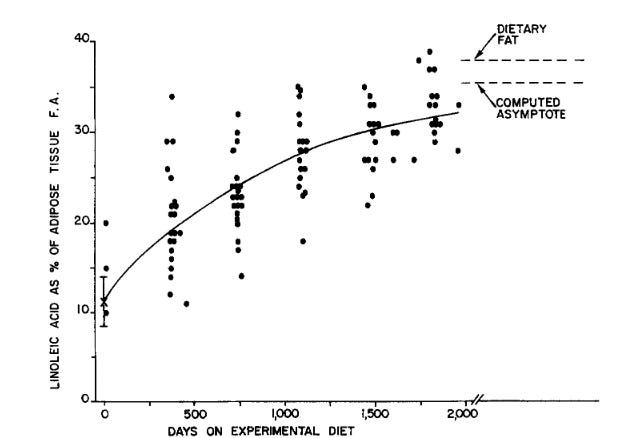
Your body constantly releases some of your body fat via lipolysis and it enters circulation, same as if you’d eaten fat that day. What that means is that even if you stop eating any seed oils or other foods with linoleic acid, you’re still getting a constant drip of it - from your own body fat!
There don’t seem to be any good studies of the time it takes to deplete linoleic acid from your body fat again, but if we just reverse the above, it sounds like 4-5 years is just about the minimum.
And yes, our modern starting point is likely as high as the seed oil-group was in the L.A. veterans study: one analysis from 2015 indicates that people’s average linoleic acid as percentage of body fat rose steadily:
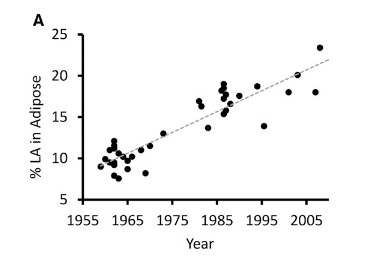
The graph ends in 2005, and people already had 17-25% linoleic acid stored. That was 20 years ago!
The slow depletion and “constant drip” of linoleic acid makes the hypothesis so tricky. It’s difficult to run studies on this, because they would have to last years. A handful, like L.A. veterans, Sydney Heart study, or Minnesota Coronary trial lasted that long, but not many. It’s just too expensive and difficult to do.
You also can’t run good randomized controlled trials (RCTs) on it, because there is no control group: anyone in the general population will, on average, be an order of magnitude too high in linoleic acid to begin with.
One analogy Tucker Goodrich likes to use: imagine an RCT about smoking and lung cancer between 2 populations, but both groups start off smoking 2 packs a day. Now you add a 3rd pack for one of the populations.
Will you see a strong correlation between smoking that 3rd pack and increased risk of lung cancer? Maybe a little, but it won’t be nearly as strong as if you found a control group without any smokers.
Today, we’re all smoking 2 packs a day when it comes to seed oils. There is no control group.
Practical advice
While you’ll likely see some improvements, even big ones, right away, just be aware that it might take years to fully deplete yourself of the excess linoleic acid your body has stored.
I lost 20lbs the first month of cutting out seed oils. But after the first 40-60lbs came off rapidly, weight loss became more of a trickle. Even 3 years in, I’m still getting small benefits all the time. Reduced overall inflammation, reduced gum bleeding. Reduced or almost vanished joint pain. Improved pain tolerance. Hugely reduced sunburns. Oh, I fixed an incurable circadian rhythm condition, one that’s legally considered an actual disability. My eyesight improved, in my late 30s. Amazing digestion, no more acid reflux or headaches.
You’ll get used to cooking most of your own food and saying no to a lot of restaurant, store-bought, or offered food. Lots of people will be confused why you would reject their food or their gifts, and you’ll learn to respectfully decline. Eventually, they’ll accept your dietary choices, especially if you’re not preachy or annoying about it. Just bring your own food and don’t make a big deal out of it. The fun is in hanging out together, the food is just an excuse to meet up.
Because the big benefits are often front-loaded and you keep experiencing a small trickle of unexpected improvements, it’s actually sort of fun to keep doing it. The variety of foods you can eat is big enough that you can play around and make it work for most any dietary preference, culture, or season.
Heck, almost all humans up until about 50-150 years ago ate a low-linoleic acid diet, and their diets were varied, delicious, and nutritious.
Checking your progress
Unfortunately it’s quite difficult to test the percentage of linoleic acid in your body fat. You’d have to get an adipose tissue biopsy, which is not easy. I haven’t been able to do so.
What you can get is an OmegaQuant Complete test, and do it fasted in the morning. It tests the fats in your blood, which consists of red blood cells (or their phospholipids, specifically), the fats you’ve eaten recently (hence doing it fasted, as not to mess with the results), and the fat coming from your own body via lipolysis.
The LA% number won’t correspond 1:1 to your adipose tissue number, because the red blood cells interfere with it. But it is a rough proxy that’ll tell you if your LA% is super high, pretty high, moderate, decent, or very low.
I’ll warn you that it’s a pretty coarse proxy. You can go a year without seeing much change.
Still, if you’re deciding to do this, it’s useful to get a baseline test very early on, and then maybe test again years later. You don’t need to test very often, and the test is $110 on Amazon without a prescription - you just poke your finger, drip blood onto a folded piece of paper, and mail it in.
Besides that, many people just go by the symptoms and the weight loss.
Related posts
If it was just linoleic acid depletion
What miracle cures should we expect from cutting out seed oils?
Do your OmegaQuant Complete fasted
Bro, do you even resaturate? OmegaQuant results
3. Find your optimal energy mix
A short recap. There are 3 macronutrients: fat, carbohydrates, and protein.
Fat and carbs are very good energy sources. Protein is not. Your body can convert protein into other substrates and generate energy in a pinch, but it’s neither efficient nor healthy, as there are byproducts.
So what else do you eat besides a modest amount of protein from e.g. beef or beans?
You either eat mostly carbs (e.g. starch based or fruit based), mostly fat (keto), or you mix the two (“swamping”).
It seems that many modern people have an easier time losing weight and keeping their hunger under control if they either stick to carbs or to fat, but don’t mix them much. This was discussed by Denise Minger in her post In Defense of Low-Fat, where she coined the term “Metabolic Swamp.”
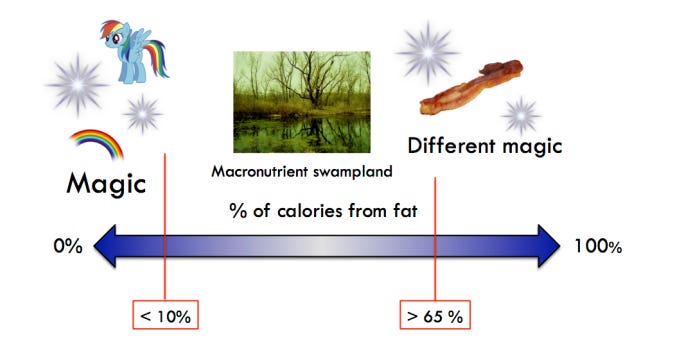
If you’re overweight, or even obese, or pre/diabetic, you’re likely going to benefit from picking either the keto or carbo side of the swamp. There are a handful of people who lose weight while “swamping” carbs and fat, but most people don’t seem to.
There are anecdotes of people cutting out linoleic acid for long enough that they were eventually able to swamp without gaining fat. Sorry to tell you this, but you’re unlikely to be the lucky one initially losing fat on an ad-lib butter croissant & ice cream diet. Many have tried.
Deplete your linoleic acid for a few years, and you might just be able to.
Practical advice - keto/HFLC
If you pick fat as your main fuel, as I did, for God’s sake be careful about your linoleic acid intake. Due to the high-fat nature of.. well, high-fat diets.. it’s VERY easy to accidentally eat huge amounts of linoleic acid. I used to pound a pound of bacon every weekend, with lots of eggs fried in the bacon grease. Whole roast chickens. A bag of nuts as a snack.
Should you pick keto, stick to dairy and ruminant fat like beef, sheep, or goat. Cook food in butter or beef tallow, which you can buy or render yourself. Avoid lard.
Stay away from dressings and sauces. I ate In-n-out “protein style” (=low-carb) burgers for years, until I realized their burger sauce is pure soybean oil.
Stay way from nuts, except macadamias.
My personal diet consist mainly of heavy cream. It’s pretty tasty, I can pour lots of it in my coffee, and I can whip it for a sort of dessert meal. Besides that, I eat a moderate amount of ground beef and green vegetables cooked in butter daily. But my main energy source is heavy cream.
Practical advice - carbo/HCLF
There are 2 main paths here, starches or fruits. Most people seem to do better on starch-based diets, but some do well on fruits or even refined sugars. This is a bit similar to the “swamping” mentioned before: if you’re metabolically unwell, your chances of refined sugar working out for you are somewhat small.
Personally I love white rice. It’s cheap, easy to prepare, delicious and easily tolerated by most people. Other people do well on potatoes. If you bake your own bread, that’s an option - just don’t buy any commercial bread in the store.
Beans go well with rice, and there are many starchy vegetables.
I don’t have as much practical advice on HCLF, but I’ve done a few months of it that I tolerated surprisingly well.
In general you can follow the advice of many vegan/whole foods plant based diets. Just ignore the negative talk about animal products in general and the purity spiral aspect of it, and add a moderate amount of beef and dairy every day. That should easily cover your bases, and vastly improve any purely vegan diet.
If you add a few pieces of fruit per day to the starch diet, that’s totally fine. Just be careful chugging gallons of OJ and eating jars of honey per day, that only works for a very small number of people.
Related posts
ex_plainrice review: I eat only white rice for 30 days
Visualizing the Swamp - Who is afraid of Walter Kempner?
4. Determine optimal protein intake
I list this after the energy mix, because it’s not as big an issue for as many people. Many people can just eat protein to appetite and do fine if they cut out linoleic acid alone, or also restrict themselves to one side of the swamp.
But some lucky people, like me, need to be careful about protein intake.
Think of protein as a building block for your body, whereas fat and carbs can fulfill your body’s energy demands. Yes, fats are also building blocks, but that’s not relevant for this part.
Your body’s requirements for building blocks (protein) is probably modest, unless you’re an athlete, bodybuilder, or you’re sick or injured. Daily maintenance for regular, even active, people is only about 40-50g of protein per day. This was tested in active, adult men.
The RDA is 0.8g of protein per kilogram (2.2lbs) of body weight, and technically that’s probably “optimal weight” and assuming you’re not obese. For me at 210lbs, even though I’m still overweight, that’s only about 76g of protein per day. At my ideal weight of 188lbs (85kg) it would be 68g of protein per day. That’s less than a pound of beef per day if you get zero protein from other sources.
In short, don’t believe the bodybuilder gurus: almost nobody in the West is undereating protein. If you like it and do well on it, sure. But if you don’t, be aware that it is a lever you can pull, and some of us have to.
Practical advice
First, this is where things get a bit individual. I estimate that only about 30% of obese people have severe issues with protein intake, like me. Another 20% or so probably benefit to a degree, but it’s not nearly as important for them.
The rest probably does fine even on high amounts of protein. These are just personal observations in the fat loss space over 20 years.
I therefore advise you to do step 1 (reduce linoleic acid) and 2 (pick an energy mix, preferably either carb or fat side of the swamp) first and try that for several months. It might be all that’s required for you to feel great, experience strong satiety, and lose weight.
But if you’ve been doing keto or carnivore for a year and aren’t losing any weight, which seems to happen in about 30% of people who try it, then try lowering your protein to a more modest amount. You’ll have to make up for it with your preferred fuel source, be that fat or carbs.
I would just slowly titrate my protein/meat intake down from where you start, toward the RDA. Once you go below the RDA you get into a bit more tricky territory and you have to be careful, because there definitely is such a thing as too little protein.
In my own case, I can do 40-45g of protein at a height of 6’1 being only moderately active. I’ve done that for 3 years now and it’s very sustainable. But if I go below that, I “bonk,” often within 4-5 days.
Your own limit may be slightly different, but the RDA should be enough for almost everyone. And going down from high protein to RDA levels should also unlock fat loss & metabolic benefits for many people.
Down with the Sickness
If you’re doing low-protein and you get sick or injured, I’d give the protein restriction up for a while. Just go up to your normal/higher protein levels until you’re fully restored to health, and add a week to be safe.
I notice that I crave way more protein when I’m sick or injured.
Also, make sure to eat extra carolies while you’re sick & injured so your body can heal. If you reach your goal weight 2 weeks later, that’s fine.
Related posts
Not losing any fat on keto/carnivore? Try eating less protein
5. Various hacks
Now we’re getting into pretty individually specific ideas, which is why this is more of a grab bag of hacks. I’m only listing the ones I personally have experience with, but there are, of course, more.
Unfortunately I can’t tell you why some of these work so well for some people, and not at all for others. I also can’t tell you how to tell what will work for you - you’ll just have to try it.
This is similar to the protein thing, except each one is probably an even lower percentage than 30%. Similarly, therefore, I recommend that you only try these if the above steps aren’t enough to get you to lose fat consistently, or if you plateau for a long time way above your optimal weight.
It’s probably best to add these 1 at a time, just so you know which ones actually have an effect on you. Or, the aggressive strategy: add all of them at the same time and if it works, remove 1 at a time until it stops working.
Vinegar
There’s a surprising literature on weight loss after nothing but supplementing vinegar to people’s diets. Personally I’ve used apple cider vinegar, white wine vinegar, and a few others. While I like the taste of vinegar, I didn’t like that it’s acidic and attacks your teeth, so I elect to just take 1 serving per day of Bragg’s Apple Cider Vinegar capsules in the morning.
The idea I’ve read is that acetic acid, the acidic part of vinegar, helps rejuvenate so-called “senescent” fat cells.
The first time I added a lot of vinegar to my meal, I experienced a very dramatic decrease in appetite and fat loss. It was quite shocking, really.
Not everybody gets this, but it’s simple enough to try.
One note: on the 1 serving per day dose, it takes me about 1-2 weeks for the effect to set in, so plan accordingly. I recommend doing a full 30 day course to give the ACV a chance to work.
ex150vinegar review: lost 4-6lbs, but nothing crazy
ex150nosauce+ACV-1 review: Down 10lbs
ex150nosauce+ACV-2 review: Blasted through plateau, new record low weight
Reduce salt & glutamate
This one was surprising to me, but cutting out (seed oil-free) sauces high in salt and tomato (glutamate) led me to some pretty dramatic weight loss. It was about the same effect as supplementing ACV, and the 2 seemed to stack when I did both, leading me to a new all-time-low weight after having plateaued for most of a year.
There’s some evidence that the polyol pathway in our body can endogenously convert glucose to fructose if excess salt or glutamate are present, and many metabolically messed up people can’t deal with fructose.
Quick review: Nature Wants Us to be Fat
Remove fructose
Speaking of fructose..
Even in a non-swampy high-carb/low-fat context, fructose can cause issues for many people. I personally get as bad hyperphagia, overeating, & fat gain on a near-zero fat, moderate-protein starch + fructose diet as I do when swamping. In practice, I was drinking OJ, eating fruit drizzled with sugar and honey, and eating dried fruit.
Some people report success on anabology’s honey diet or the more recent sugar diet, but neither have worked well for me.
If you’re eating quite a bit of sugar beyond a handful of pieces of fruit a day on a HCLF diet, and not feeling satiated or losing fat, I’d try to cut out that fructose.
ex150honey review: gained 5.4lbs lean mass, no fat loss
ex_sugar review: Spectacular failure in 9 days
Other ideas
There are more such little “hacks” including MCT oils, the amino acid glycine, and some people report improvements by supplementing vitamin B1. I’m only listing those that I’ve personally seen benefits from here. These are pretty specific to the individual anyway, and it’s more of a grab bag. If you’re not yet completely happy with how things are going, try some of these and do some research on what has worked for others.
Now that we’ve covered THE ALGORITHM in detail, let’s elaborate on the general advice that goes along with it.
Conditional on Excess Linoleic Acid
There is some anecdotal and historical evidence that humans can, in principle, eat a swampy diet with mixed crabohydrates and fat, yet remain healthy & lean.
The “French Paradox” is one such example: the French ate refined white flour with butter and cheese, and they also ate quite a bit of sugar, and were healthy. Your grandparents probably did; mine did for sure. Bread & butter, meat & potatoes, butter cookies for dessert.
Just like people didn’t have to count calories or exercise them off in the past, and everyone’s appetite just mostly worked, most people could eat from either energy macro or mix them without much of an issue.
Similarly, the protein issue and the various little hacks might not be necessary if you’re not pathologically loaded up with linoleic acid.
Besides historical examples, we do actually have some people who’ve restricted linoleic acid for a few years now, and have made big improvements in their ability to handle these food combinations.
This includes formerly obese and even diabetic people who can now eat pretty much whatever they want, not gain weight, and maintain stable blood sugar - while restricting linoleic acid, of course.
Personally I am clearly not quite there (yet). While I would say my satiety has improved when doing high-protein or mixed macro refeeds, I still get pretty hyperphagic and gain fat rapidly.
There’s no guarantee that any of us will ever be “fixed” by cutting out & depleting linoleic acid, but enough people are doing it now that I think we should see some interesting results in a handful of years.
Practical advice
I’d recommend that even if you dial in a certain diet, say low-PUFA, low-protein keto in my case, you still try other things once in a while. For me that usually takes the form of a monthly refeed for 2-4 days.
But maybe run a month-long diet experiment that isn’t just more of the same - that’s how I found out that cutting out linoleic acid seems to have fixed my life-long circadian rhythm disorder. Had I not tried eating carbs for a month, I might’ve never found out.
In case that needs to be said: I don’t recommend you ever “try” eating a high-linoleic acid diet again, be it for a few days or for months. You might eventually get to a point where you can eat a modest amount, or eat seasonal foods that contain a lot of linoleic acid (e.g. nuts), but it might just be better to strictly limit LA forever. There is some pretty convincing evidence that lipid peroxidation is one of the culprits in aging and all its negative side effects.
Run 30 day experiments
I think 30 days is pretty much the optimal default time frame for diet experiments. It’s the goldilocks zone: too long for most people to just “power through” an otherwise unsustainable diet, but short enough that you can pull off a diet that is maybe not your favorite (plain white rice diet, anyone?)
30 days should show you a weight loss trend and cut through the daily noise of weight fluctuations most people experience. Nothing is more frustrating than running an experiment and then concluding “who knows, it just went up and down.”
If you’re not seeing a significant trend over 30 days, assuming you start out with significant fat to lose, the diet is not doing anything.
At the same time, if you do lose significant weight but you hate every second of it and had to force yourself to finish, that’s probably not a great long-term diet for you either.
Short experiments
Sometimes, shorter experiments make sense. I’ve done several experiments that I never planned on doing for longer than 7 or 14 days. Other I planned on doing for 30, but had to quit because they turned out to be unsustainable.
Here are some reasons to plan shorter experiments:
You’re pretty sure it’s not going to be sustainable for 30 days, and the downsides could be significant (in terms of general health, or fat gain). For example fasting, which most people can’t do even for a week. Anything that has made you hyperphagic or gain fat in the past, e.g. prolonged high protein or fructose intake for me. Anything involving explicit force-feeding or overeating - I once added 1,000kcal of coconut oil to my diet every day on purpose. I did not plan on doing this for 30 days.
You suspect that the dynamic between refeeds and the actual diet is significant. E.g. maybe it’s not the “low protein diet” that helps you lose fat, but the act of switching between high and low protein. Some people speculate that switching between keto and carbo could help deplete linoleic acid faster. In this case, a 30 day cycle might be suboptimal. On the other hand, switching daily might also not work well. It’ll depend on the individual hypothesis you’re testing, case by case.
Whatever hypothesis you’re testing should be answered by day 7 or day 14. For example, I’m currently testing the hypothesis that supplementing ACV and reducing sodium & glutamate sauce intake will help me linearly lose weight below my previous all-time-low (ATL), or if it just helped me get back down to the ATL more quickly. If you are currently at your ATL, you might not have to do a 30 day experiment to answer that question. If you do it for 14 days and lose 3lbs, there is your answer. On the other hand, only losing 1lbs over 7 days might not be a clear enough trend to be distinguishable from noise. In that case, you might want to extend the experiment until a clear trend emerges, or enough time has passed (say 30 days) to confirm there is no trend.
For logistical reasons. Say it’s 2 weeks from Christmas and you know you’ll be cheating during family meals over the holidays. One option is to just give up now and eat whatever for the next 2 weeks, because a 30 day experiment won’t fit. Another option is to just run a shorter, 2-week experiment of something you think has a reasonable chance of working. If you don’t have a hypothesis you think can be answered in 2 weeks, you could just run another iteration of something that tends to work well for you - I’ve run ex150 style experiments for dozens of times now, nearly unchanged. “Does it still work?” is a reasonable experiment.
Longer experiments
There are diet ideas out there, and strategies, that won’t work over just 30 days. For example, many “depletion” strategies, including depleting linoleic acid from your adipose tissue, will likely take years. Another popular such strategy is depleting stored vitamin A from your liver, a strategy promoted by Grant Genereux. Similar to LA, this will take years of a consistent low-vA diet.
Another thing that won’t fully work in a month is, for example, getting started with a ketogenic diet. Sure, you might see some benefits during the first month. But it typically takes quite a bit longer than that to fully adapt to it. Some studies say at least 6 weeks, others say way longer. I believe I’ve seen up to 18 months to fully adapt!
I honestly couldn’t tell you how long it took me 10 years ago, but for example my carb cravings went away around 12 months in - quite a wait.
One longer term experiment I am interested in doing one of these days: 6 months of continuous low-fat, rice based HCLF with moderate beef. Basically replacing the cream on ex150 with rice & beans. This would actually be pretty close to Grant’s original low-vitamin A diet.
Why do this? The idea is that eating super low-fat might deplete linoleic acid from adipose faster, even compared to a low-linoleic, high-fat diet like my ex150 heavy cream diet. If that is really the case is speculation at this point.. but hey, I like trying things. Since even an accelerated depletion effect would still take a very long time, 6 months is just about the shortest time span that I’d expect to produce a visible effect.
Related posts
Fail Fast: I quit a glass noodle experiment after only 1 day
Low-fat diets better at depleting Linoleic Acid?
Weigh yourself every day
This one’s pretty self explanatory, but some people have an aversion to it. I recommend you overcome that aversion.
If you’re worried about being scared by big jumps in weight from day to day, don’t: for one, eating a very consistent & repetitive diet tends to eliminate most of these jumps. Second, you can just use a rolling average to “judge” yourself.
You’re not trying to score yesterday’s diet anyway, that’s much too short term to tell you anything about its efficacy. You’re running 30-day experiments, and you’ll be judging 30 days at a time.
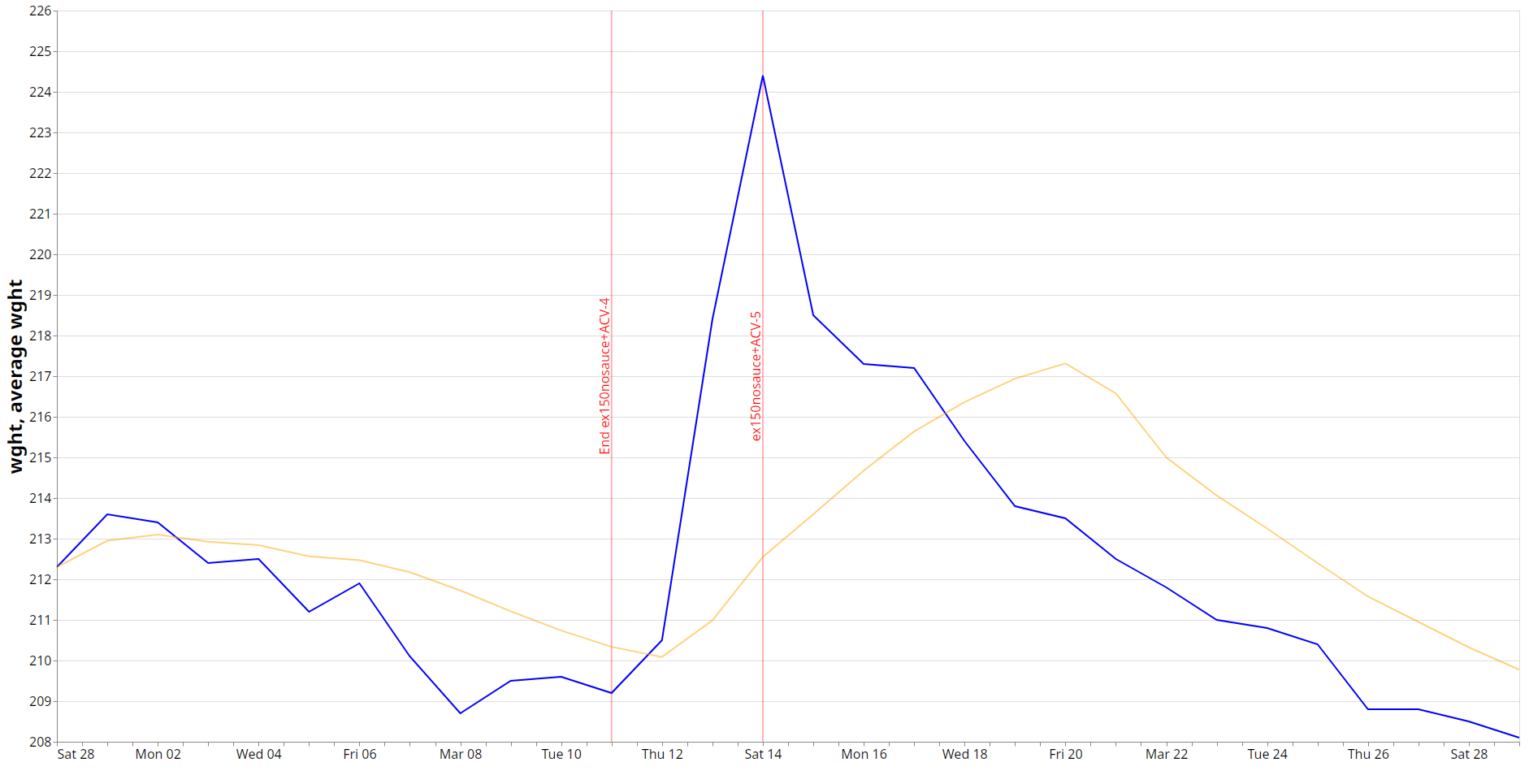
I use the rolling average of my last 7 days’ weigh ins. That means even when I do a refeed, my weight only goes up by maybe 5-7lbs before it slowly stabilizes and trends back down. Day to day I don’t even see any noise.
Look at this graph of my weight over the last 30 days. There’s an insane peak of going from 209lbs to 224lbs in just 2.5 days of refeed, but the average (yellow line) only ever, slowly, reaches 217lbs.
The average is much smoother and less prone to make you overreact.
Why the scale?
I’ve written about this before, but I think the scale is still the best tool for daily tracking. It’s fine to measure your waist circumference, but in my experience it’s far less accurate and more noisy. I know people disagree on this, and maybe it’s different for different people, but it’s always been the case for me.
Scales that pretend to measure your body weight fat tend to be extremely inaccurate. Even DEXA scans are pretty inaccurate on “lean” mass, in the sense that water is lean aka non-fat mass. You can therefore change your “lean mass” and body fat percentage drastically just by increasing/decreasing water intake or retention.
That said, I still get a DEXA scan every couple of months, just to verify. Usually it’s pretty much in line with what the scale has been telling me anyway.
Related posts
Why I measure my progress with a boring old scale
Losing Weight with Unix: How I track All The Things
Rapid Fat Loss at first, then a slow trickle
You’ll likely lose a bunch of weight in the beginning, but then it’ll slow down to a trickle, and you’ll slowly approach your optimal weight over a few years. I personally went from morbidly obese, through obese, and I’m now about in the middle of the “overweight” range (BMI 27.6 this morning). The entire time, I didn’t restrict my carolies and I didn’t exercise much at all.
Almost everybody’s weight loss graph looks like exponential decay, not linear. (If you’re not currently obese or very overweight, your weight loss might not be as dramatic. You might reach your goal weight in only a few months. Lucky you! This is really for people struggling to reverse their obesity.)
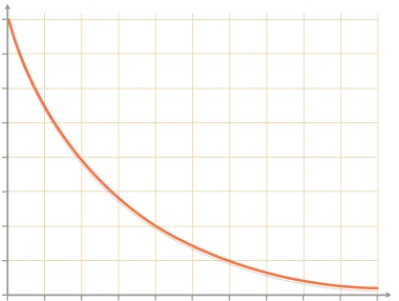
Cutting out linoleic acid tends to fix your appetite and your body’s ability to use its own stored fat. All the quality of life improvements are a nice bonus to keep you motivated.
Stick with the program, and don’t panic when you plateau for a while, even a few months. Eventually, a weight plateau while you’re still quite a ways away from your optimal weight might deserve action or a change of plan. But it’s never a good idea to panic.
Give it another 2 months of the same experiment. If you’ve lost zero pounds over 2 separate, strict 30 day experiments, on a diet that you’ve previously lost a lot of weight on, you can start tweaking it - maybe try some of the random “hacks” from step 5, like cutting out salt or glutamate (=tomatoes, mushrooms).
Related posts
“Water weight” - temporary fluctuations during fat loss
My Constituency: Tough Obesity Cases
Conclusion
There you have it, folks. This is pretty much my entire obesity & fat loss paradigm as of early 2026. I think that, at 7,700 words, this is the second longest post I’ve written so far after Sleep, Jet Lag & Circadian Rhythm.
Find you a girl who loves you as much as I love typing.
I dig this a lot. I like the idea of having an 'approach' moreso than a 'prescription'.
Really loving your work. Love that you're willing to entertain the whole spectrum. It's so necessary to regaining this 'approach'.
I myself am underweight. I'm about 5'11. Through my late teens/early 20s I weighed 125. I've been able to get up to 140 by going much more keto (it's not about 'weight loss'; it's about 'homeostasis'!). I'm nowhere near as thorough as you but I've just been slowly modifying my diet; noticing "how do I feel" on different things. I am finding that adding in a few carbs (no more than 20% of calories; into the swamp is horrible) gets me way more "regular" in terms of gut feeling and energy level. In the winter I do a lot of standing outside in the cold (farm life) and this has been my best winter yet - I am starting to finally have the circulation and body fat required to endure it.
A bit late to the party, but I think I have my own N=1 observations to contribute.
You see satiety as the signal to track. It absolutely doesn’t work for me.
I have never, in my life, felt satiety. Okay, I’m lying. I have, once time, a few months a go, for the first time, and never again. I was sick with COVID, 2 days stuck in bed. When I got better, I prepared a meal, and halfway through it, I had that weird, previously-unknown to me feeling of "I’ve eating enough even if I’m not full ; I could force myself to eat more I guess, but I really don’t want to".
It was awesome. I want to feel that again. It’s just I just don’t normally work that way : I can eat as much as I want until physical fullness, without feeling any point of "it’s enough" along the way. It has always been that way for as long as I can remember ; I don’t think it’s a "seed oiled" thing.
Instead, my food intake is (poorly) "regulated" that way : I have two "eat" impetus :
* Habits becoming physiological expectations in terms of timing and quantity. If I eat 4 slices of bread in the morning for two weeks, then if one day I skip it, I will not necessary get _hungry_, but I will quickly have a "craving for slices of bread" : mouth salivating, taste buds expecting/wanting slices of bread, wanting to chew and swallow something having the same mouth-feeling as bread. It is a pretty strong thing. And going to 3 slices of bread trigger it at a lower intensity. Fighting it requires a quite large quantity of willpower.
* Usual hunger, if my intake from my habits is clearly metabolically insufficient. "Stomach growling". I think everyone knows this.
The first is a ratchet (because I can add I much as I want to my habits and there’s absolutely no signal that says "nope, too much", outside of fullness that takes a lot, but subtracting to my habits require a lot of willpower). The second cranks it (it’s getting colder => I’m getting constantly more hungry => I’m adding a bit of chocolate at breakfast => it’s now locked in as an expectation by my food reward circuitry). The outcome is obvious.
In short : your idea of "just find what you can eat to satiety, don’t rely on willpower" is probably not as the "obvious/universal starting point" as you make it (exhibit two would be Yudkowsky — I know you know his case).
Also, in that light, "CICO" makes more sense ; if I can "lie" to my first system as to what constitute the "habitual meal" (ie : keeping quantities/timing/overall taste/consistency the same, substituting real food with "low caloric substitutes"), then that "kinda" "works"… (clearly not a silver bullet tho).
And I don’t think the "eat less, move more" idea is completely ridiculous non-sense. Sure, it doesn’t explain the bulk of the obesity epidemics by itself, and if you think It’s The Only Answer you’re going to solve the wrong problem using the wrong methods… But that idea that "you can eat too much, and if you do you get unhealthily fat" was an idea you can find in medical writings from _antiquity_. It cannot be just "heh, but that too much is just driven by seed oils right ?". There is probably something such as "overeating".